
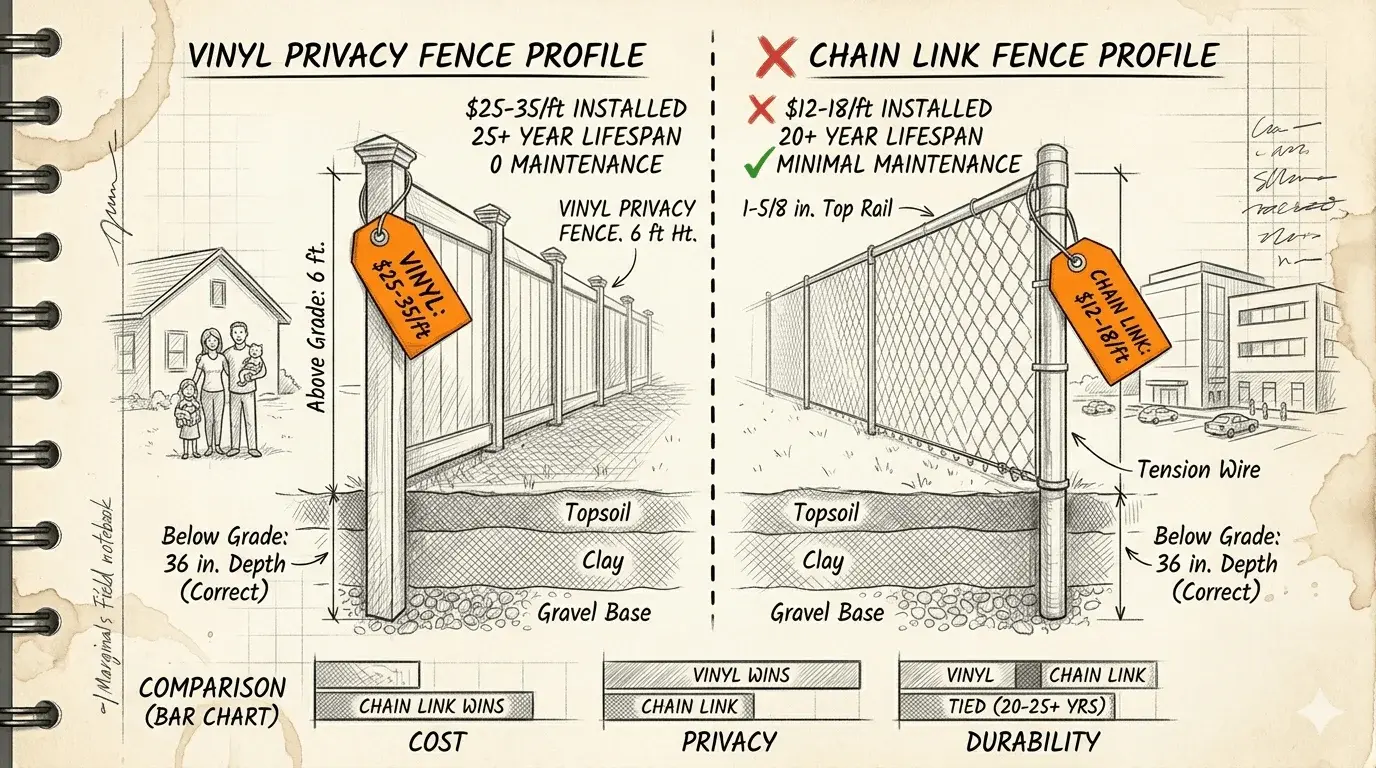
Vinyl vs. Chain Link Fence: A Contractor's Guide to Recommending the Right Material
Last Tuesday, a homeowner in Scottsdale asked her fence contractor whether she should go vinyl or chain link for her 280-linear-foot backyard perimeter. The contractor quoted both options, and the price difference was $4,760. That gap changes the conversation. Knowing when to push vinyl, when chain link is the smarter call, and how to frame the comparison for different customer types is a skill that separates order-takers from trusted advisors. This guide gives you the numbers, the specs, and the talking points for every vinyl-vs-chain-link conversation you will have this year.
Cost Comparison: Materials and Installed
Cost is the first question out of every customer's mouth. Here are the real numbers, updated for 2026 material pricing. These reflect wholesale cost from suppliers like NMI and typical contractor labor rates, not retail big-box pricing.
| Cost Category | Chain Link Fence | Vinyl Fence |
|---|---|---|
| Materials per linear foot (4 ft height) | $5 - $9 | $12 - $22 |
| Materials per linear foot (6 ft height) | $7 - $14 | $18 - $35 |
| Installation labor per linear foot | $8 - $15 | $12 - $20 |
| Total installed per linear foot (4 ft) | $13 - $24 | $24 - $42 |
| Total installed per linear foot (6 ft) | $15 - $29 | $30 - $55 |
| Gate (single walk, installed) | $175 - $350 | $250 - $500 |
| Gate (double drive, installed) | $350 - $700 | $500 - $1,000 |
| Cost per 100 LF (6 ft, installed) | $1,500 - $2,900 | $3,000 - $5,500 |
| Cost per 200 LF (6 ft, installed) | $3,000 - $5,800 | $6,000 - $11,000 |
The math is clear: chain link runs 40-55% less than vinyl on a per-foot basis. For a typical 200-linear-foot residential job at 6-foot height, the customer saves $3,000 to $5,200 by choosing chain link. That savings pays for a patio, a shed, or three months of mortgage payments. It is real money, and you should present it honestly.
But cost per foot is not cost per year. That is where the conversation shifts.
Lifespan and Long-Term ROI
Chain link fence, galvanized with a Class 1 zinc coating (1.2 oz/sq ft), lasts 15-20 years before visible corrosion appears. Vinyl-coated chain link extends that to 20-25 years. A quality vinyl fence with UV-stabilized PVC and aluminum or galvanized steel internal reinforcement lasts 25-35 years with no structural maintenance.
Here is the ROI calculation contractors should walk through with customers who are weighing upfront cost against lifespan.
| Metric | Chain Link (Galvanized) | Chain Link (Vinyl-Coated) | Vinyl (Privacy) |
|---|---|---|---|
| Installed cost (200 LF, 6 ft) | $4,000 | $5,200 | $8,500 |
| Expected lifespan | 15-20 years | 20-25 years | 25-35 years |
| Annual maintenance cost | $50-$100 (rust treatment) | $25-$50 | $0-$25 (hose rinse) |
| Replacement in 30 years | 1-2 replacements | 1 replacement | 0-1 replacement |
| 30-year total cost of ownership | $9,500 - $12,000 | $7,200 - $10,400 | $8,500 - $10,000 |
| Cost per year of service | $267 - $400 | $264 - $347 | $243 - $333 |
| Property value impact | Neutral to slightly negative | Neutral | +2% to +5% (privacy benefit) |
Over 30 years, vinyl and vinyl-coated chain link end up remarkably close in total cost. Standard galvanized chain link is the most expensive option on a 30-year basis because it needs replacement sooner. This is powerful information for closing a vinyl sale with a budget-conscious customer.
When to Recommend Vinyl
Vinyl is the right recommendation when the customer's priorities align with its strengths. Here are the five scenarios where vinyl wins.
1. Residential Privacy
A 6-foot solid vinyl privacy fence blocks 100% of sightlines. Chain link blocks approximately 0%. Even with privacy slats, chain link only achieves 70-85% visual screening. For customers who want complete backyard privacy, vinyl is the only single-product solution. No add-ons, no combinations.
2. Curb Appeal and Property Value
Real estate data from the National Association of Realtors shows that a well-maintained fence adds 1-3% to home value. A vinyl privacy fence specifically adds 2-5%, while chain link adds 0-1% and can actually reduce curb appeal in some markets. In neighborhoods with homes valued above $350,000, vinyl is almost always the right recommendation. The fence becomes part of the landscaping, not a utilitarian boundary.
3. Low-Maintenance Customers
Vinyl fence maintenance consists of an annual rinse with a garden hose. No painting. No staining. No rust treatment. No replacement of corroded tie wires. For customers who explicitly say "I don't want to maintain it," vinyl eliminates every recurring task. Chain link requires periodic inspection for rust spots, re-tensioning of sagging fabric, and replacement of bent or broken tie wires. The labor is minimal, but it exists.
4. HOA-Governed Communities
Over 60% of HOAs in the Sun Belt prohibit chain link fencing in front and side yards. Many prohibit it entirely. Vinyl is the default-approved material in most HOA design guidelines. Before quoting chain link in an HOA community, pull the CC&Rs. If chain link is prohibited, the conversation is over before it starts.
5. Pool Barriers (Where Climbability Matters)
Solid vinyl panels are non-climbable and pass the 4-inch sphere test by default. Chain link mesh provides footholds for climbing. In jurisdictions that enforce climbability requirements for pool barriers (including Maricopa County, AZ and parts of Southern California), vinyl is the simpler path to code compliance.
When to Recommend Chain Link
Chain link fence has advantages that vinyl cannot match. Here are the scenarios where chain link is the clear winner.
1. Commercial and Industrial Properties
A 500-linear-foot commercial perimeter at 6-foot height costs approximately $7,500-$14,500 in chain link vs. $15,000-$27,500 in vinyl. For warehouses, storage yards, construction sites, and industrial facilities, chain link delivers security at roughly half the cost. Add 3-strand barbed wire or razor ribbon for $2-$4 per linear foot, and you have a security perimeter that vinyl cannot replicate at any price.
2. Security Applications
Chain link with barbed wire topping, in heights from 6 to 12 feet, is the standard security barrier for commercial properties. Vinyl tops out at 8 feet for most manufacturers and cannot accept barbed wire or razor ribbon toppers. For any application where the primary purpose is keeping people out (or in), chain link is the correct material. Add privacy slats if visual screening is also needed.
3. Budget-Constrained Residential
Not every homeowner can spend $8,500 on a fence. For customers with firm budgets under $5,000 for a full-yard perimeter, chain link is the only option that delivers a complete, code-compliant enclosure. Present vinyl-coated chain link (approximately 30% premium over galvanized) as a mid-range option that improves aesthetics without reaching vinyl pricing. Black vinyl-coated chain link, in particular, nearly disappears against dark landscaping backgrounds.
4. Temporary and Short-Term Installations
Construction sites, event perimeters, and rental properties benefit from chain link's lower upfront cost and easier removal. A temporary chain link fence can be installed with driven posts (no concrete) and removed without permanent damage to the site. Vinyl fence posts require concrete footings and leave 8-12-inch diameter holes when removed. For any installation expected to last less than 5 years, chain link is the economical choice.
5. Large-Acreage Properties
Fencing 5+ acres means 1,000+ linear feet of material. At that scale, the per-foot cost difference between chain link and vinyl translates to $15,000-$30,000 in savings. Rural and semi-rural properties with large lots are chain link territory. The visual impact is minimal at distance, and the cost savings is substantial.
Installation Time Comparison
Installation speed directly affects your labor cost and project scheduling. Here is how the two materials compare for a typical 2-person crew.
| Project Scope | Chain Link Installation Time | Vinyl Installation Time |
|---|---|---|
| 100 LF, 4 ft height, flat grade | 4-6 hours | 6-8 hours |
| 100 LF, 6 ft height, flat grade | 5-7 hours | 7-10 hours |
| 200 LF, 6 ft height, flat grade | 1 - 1.5 days | 1.5 - 2 days |
| 200 LF, 6 ft height, with slope | 1.5 - 2 days | 2 - 3 days |
| Single walk gate | 30 - 45 minutes | 45 - 90 minutes |
| Double drive gate | 45 - 90 minutes | 90 - 120 minutes |
Chain link installs approximately 25-35% faster than vinyl on comparable projects. The speed difference comes from three factors. First, chain link fabric is a continuous roll that covers multiple bays in a single pull, while vinyl panels must be placed individually. Second, chain link posts are smaller diameter (1-5/8" to 2-3/8" line posts vs. 4" to 5" vinyl posts), requiring smaller post holes. Third, chain link allows faster field adjustments on sloped terrain because the fabric can be racked diagonally without pre-ordered custom panels.
For your business, faster installation means more jobs per week. A crew that installs 200 feet of chain link in one day can take on 5 jobs per week. The same crew installing vinyl at the same footage completes 3-4 jobs. If your crew's loaded labor rate is $800/day, that extra day per vinyl job costs you $800 in opportunity cost. Factor that into your pricing.
Warranty Differences
Warranty terms vary by manufacturer, but the general patterns are consistent across the industry.
Chain link: Most chain link manufacturers warrant the galvanized coating against manufacturing defects for 10-15 years. Vinyl-coated chain link carries 15-20-year warranties on the coating. The steel wire itself is typically warranted for the life of the original installation, but "life" is loosely defined and rarely tested. Gate hardware (hinges, latches, rollers) is warranted separately, typically 1-3 years.
Vinyl: Quality vinyl fence manufacturers offer lifetime limited warranties that cover cracking, peeling, flaking, blistering, and abnormal weathering. "Lifetime" means the life of the original purchaser or 50 years, whichever is shorter. The warranty does not cover damage from impact, improper installation, or Acts of God. Color fade is covered for 5-10 years on most colored (non-white) vinyl. White vinyl has the longest fade warranty because titanium dioxide, the UV stabilizer, is inherently white.
From a contractor's perspective, the vinyl warranty is a stronger selling point. "Lifetime warranty against cracking and peeling" resonates with homeowners more than "15-year coating warranty on galvanized wire." Use the warranty conversation to reinforce the long-term value proposition of vinyl.
Climate Considerations
Geography should influence your recommendation. Both materials have climate vulnerabilities that contractors need to understand and communicate.
Vinyl in Cold Climates
PVC becomes brittle below 20 degrees Fahrenheit. Impact that would cause a minor flex at 70 degrees can crack a vinyl rail or picket at -10 degrees. This is a real concern in northern states. A snowblower throwing a chunk of ice, a fallen branch, or even a hard slam of a gate can fracture cold vinyl. Quality manufacturers add impact modifiers to their PVC compound that improve cold-weather performance, but the risk does not disappear entirely.
Practical guidance for cold-climate vinyl installations: use manufacturers that specify impact-modified PVC (check the spec sheet for "impact modifier" or "CPE content"), install gates with soft-close stops to prevent slamming in winter, and advise homeowners to avoid leaning heavy objects (ladders, lumber) against the fence in freezing temperatures.
Chain Link in Coastal and Humid Climates
Salt air accelerates corrosion of galvanized steel. A standard Class 1 galvanized chain link fence within 1 mile of saltwater can show rust in as few as 5-7 years, compared to 15-20 years inland. For coastal installations, specify one of three options:
- Vinyl-coated chain link: The PVC coating provides a secondary barrier against salt. Adds 25-35% to material cost. Expected coastal lifespan: 15-20 years.
- Aluminum-coated (aluminized) chain link: The aluminum coating resists salt better than zinc. Not widely stocked but available through specialty distributors. Expected coastal lifespan: 20-25 years.
- Stainless steel chain link: Type 304 or 316 stainless. Virtually corrosion-proof in coastal environments. Material cost is 3-5x galvanized. Reserved for high-end waterfront properties or commercial marine applications.
Both Materials in High-Wind Zones
Chain link is inherently wind-resistant because the open mesh allows air to pass through. A 6-foot chain link fence with 2-inch mesh presents approximately 35% solid surface area to wind. A 6-foot solid vinyl privacy fence presents 100%. In a 90 mph wind event, the force on a 6-foot vinyl privacy panel is roughly 2.8 times the force on an equivalent chain link section.
For high-wind zones (coastal Florida, Gulf Coast, tornado-prone Midwest), chain link has a structural advantage. Vinyl privacy fences in these areas need deeper post footings (36-42 inches minimum vs. the standard 24-30 inches), closer post spacing (6 feet on-center instead of 8), and heavier-gauge internal reinforcement. Some vinyl manufacturers offer wind-rated panels tested to 110+ mph, but they cost 20-30% more than standard panels.
Semi-privacy vinyl styles with 1-inch gaps between boards reduce wind load by approximately 15-20% compared to solid privacy panels while still providing 75-80% visual screening. They are a reasonable compromise in moderate wind zones.
Pros and Cons Side by Side
| Factor | Chain Link - Pros | Chain Link - Cons | Vinyl - Pros | Vinyl - Cons |
|---|---|---|---|---|
| Cost | 40-55% less upfront | Higher 30-year cost if replaced | Lower cost per year of service | Higher upfront investment |
| Privacy | Can add slats for 70-85% | Zero privacy as-installed | 100% privacy (solid panels) | No option for see-through security |
| Security | Barbed wire, razor ribbon options | Easily climbed without toppers | Difficult to climb (no footholds) | No barbed wire or topper options |
| Maintenance | Minimal annual effort | Rust treatment every 3-5 years | Hose rinse once a year | Cracks cannot be patched (replace section) |
| Aesthetics | Utilitarian, clean lines | Institutional appearance | Clean, modern look | Limited color options (white, tan, gray) |
| Installation speed | 25-35% faster than vinyl | Stretching fabric requires experience | Panel-by-panel, consistent process | Heavier posts, larger holes |
| Wind resistance | Excellent (open mesh) | Slats increase wind load | Semi-privacy styles fair well | Solid panels catch full wind load |
| Cold weather | No temperature concerns | N/A | Impact modifiers help | Brittle below 20 degrees F |
| Coastal/salt | Vinyl-coated option available | Standard galvanized rusts in 5-7 years | PVC is salt-proof | Hardware (hinges, screws) can corrode |
| Property value | Neutral to negative | Can reduce curb appeal | +2% to +5% | Diminishing returns on properties under $200K |
The Hybrid Approach: When Both Materials Make Sense
Some properties benefit from using both materials in different zones. This is an underutilized strategy that can increase your average ticket size by 30-50% while genuinely serving the customer's needs.
Front and side yards: Vinyl privacy or semi-privacy fence for curb appeal and HOA compliance. Typical run: 80-150 linear feet.
Rear perimeter: Chain link with vinyl coating for cost-effective enclosure along rear property lines that border woods, alleys, or commercial properties. Typical run: 100-200 linear feet.
Dog run or utility area: Chain link for a dedicated 10x20-foot dog kennel or trash enclosure. Typical run: 60-80 linear feet with a gate.
A 350-linear-foot residential perimeter with 120 feet of vinyl in front ($4,200-$6,600), 180 feet of vinyl-coated chain link in rear ($3,240-$5,220), and a 50-foot dog run ($750-$1,450) totals $8,190-$13,270. An all-vinyl quote for the same perimeter would run $10,500-$19,250. The hybrid saves the customer $2,300-$5,980 while delivering vinyl where it matters visually. Present this as a "zoned fencing" approach.
What About Aluminum?
When the conversation is vinyl vs. chain link, aluminum fence and rail sometimes enters as a third option. Aluminum occupies the middle ground: more aesthetically appealing than chain link, lower maintenance than wood fence, and less expensive than vinyl for comparable decorative applications. For pool barriers, property boundaries where privacy is not needed, and front-yard accent fencing, aluminum is worth presenting. But it is not a direct competitor in either the privacy (vinyl) or the budget/security (chain link) categories.
Closing the Sale: How to Present the Comparison
When you sit at the kitchen table with a homeowner, frame the conversation around their stated priorities, not around the materials themselves.
If they say "privacy," lead with vinyl. Show the solid panel, explain the zero-maintenance benefit, and present the cost-per-year figure instead of the upfront total. A vinyl fence at $283 per year over 30 years sounds different than $8,500 today.
If they say "budget," lead with chain link but present three tiers: galvanized ($4,000), vinyl-coated ($5,200), and chain link with privacy slats ($6,800). The middle option anchors the conversation, and the slat option gives them privacy at $1,700 less than full vinyl.
If they say "security," lead with chain link and focus on the add-ons: height (up to 12 feet), barbed wire, razor ribbon, and tension wire at the bottom. No other residential fencing material offers this combination.
If they cannot decide, propose the hybrid "zoned fencing" approach. It gives them vinyl where guests see it and chain link where cost matters. You close a larger total job, the customer gets a tailored solution, and you differentiate yourself from the contractor who only quoted one option.
Frequently Asked Questions
Which fence lasts longer, vinyl or chain link?
Vinyl fence typically lasts 25-35 years with virtually no maintenance, while galvanized chain link lasts 15-20 years before corrosion becomes visible. Vinyl-coated chain link splits the difference at 20-25 years. On a cost-per-year basis over 30 years, vinyl and vinyl-coated chain link are within $20-$70 per year of each other, making the longevity advantage less significant than the upfront cost suggests.
Can you add privacy to a chain link fence later?
Yes. Privacy slats can be inserted into existing chain link mesh without removing the fabric. Slats provide 70-85% visual screening and cost $3-$7 per linear foot for materials. Installation takes approximately 15-20 minutes per 10-foot section. Slats are available in colors to match vinyl-coated chain link (green, black, brown, white) and add minimal wind load compared to solid fence panels.
Is vinyl fence strong enough for large dogs?
Quality vinyl fence panels withstand 200-300 pounds of lateral force before flexing noticeably. A 100-pound dog hitting the fence at a run generates approximately 150-200 pounds of impact force. Solid privacy panels handle this without damage. Picket-style vinyl panels with individual pickets are more vulnerable because a determined dog can break a single picket (rated at 40-60 pounds of breakage force). For large, active dogs, specify solid privacy panels or reinforced picket panels with aluminum inserts.
Does chain link fence affect home resale value?
In most residential markets, chain link has a neutral to slightly negative impact on perceived property value. A 2024 survey by the American Fence Association found that 68% of real estate agents consider chain link a negative factor in curb appeal for homes priced above $300,000. Below that price point, the impact is negligible. Vinyl-coated chain link in black or green is viewed more favorably than standard galvanized because it blends with landscaping.
Which is better for slopes, vinyl or chain link?
Chain link is easier to install on slopes because the mesh fabric can be racked (angled) continuously along a grade change without cutting or custom panels. Vinyl fence handles slopes through either racking (tilting the panel to follow grade, limited to about 15 degrees) or stair-stepping (each panel is level, with gaps filled underneath). Stair-stepping creates triangular gaps at the bottom that may need fill panels. For grades exceeding 15%, chain link is significantly faster and cheaper to install.