
Vinyl Fence Installation: The Contractor's Complete Field Guide
A 6-foot vinyl privacy panel weighs roughly 22 pounds. A 6-foot wood panel of the same dimensions weighs closer to 65 pounds. That weight difference changes everything about how your crew moves through a job, from the number of laborers you need to the total install time per linear foot. A competent two-person crew can install 100 to 150 linear feet of vinyl fence in a single day, compared to 75 to 100 linear feet of wood. But only if the layout, post spacing, and concrete work are done right from the start.
This guide covers every step of vinyl fence installation from property survey to final gate adjustment. It is written for contractors who have installed other fence types but want a reliable, repeatable process for vinyl. Every measurement, tool, and technique here comes from field-tested methods, not manufacturer marketing sheets.
Tools and Materials Checklist
Before your crew leaves the shop, confirm every item on this list. A missing tool on a vinyl job costs you more time than on wood or chain link because vinyl components are precision-fit. You cannot force, shim, or improvise without visible damage.
| Category | Tool / Material | Purpose |
|---|---|---|
| Layout | 100-ft tape measure | Full-length property measurement |
| Layout | String line (mason's line) | Straight alignment between corners |
| Layout | Wooden stakes (24" min) | Anchor points for string lines |
| Layout | Spray paint (marking) | Post hole center marks on ground |
| Digging | Post hole digger or power auger | Hole excavation, 10" diameter minimum |
| Digging | Digging bar | Breaking through roots and rocky soil |
| Setting | 4-ft level | Plumb check on posts |
| Setting | Post level (straps to post) | Hands-free plumb verification during pour |
| Setting | Premixed concrete (50-lb bags) | Post anchoring, 1-2 bags per post |
| Setting | Gravel (pea gravel or crushed stone) | 4-6" drainage base in each hole |
| Assembly | Rubber mallet | Seating rails and panels without damage |
| Assembly | PVC cement / adhesive | Bonding post caps, optional rail joints |
| Assembly | Cordless drill with #2 square bit | Bracket screws, gate hardware |
| Assembly | Stainless steel screws (exterior grade) | Bracket and hinge fastening |
| Cutting | Miter saw with fine-tooth carbide blade (80T) | Clean cuts on posts and rails |
| Cutting | Oscillating multi-tool | Notching posts for retrofit situations |
| Safety | Safety glasses, gloves, ear protection | Standard PPE for cutting and drilling |
Step 1: Property Survey and Layout
Every vinyl fence job starts at the property pins. Locate them with a metal detector or hire a surveyor if the pins are buried or missing. Installing even 6 inches onto a neighbor's property can mean tearing out the entire run. That is an expensive mistake on a material that costs $20 to $40 per linear foot installed.
String Line Method
Drive a wooden stake at each corner and end point of the fence line. Pull a mason's string line tight between stakes, 4 inches above ground level. This line represents the face of your posts, not the center. Keep the string on the side of the posts that faces the neighbor (the "good side out" convention).
Walk the entire string line before digging a single hole. Check for these issues:
- Grade changes greater than 6 inches between post locations (requires stepping or racking)
- Underground utilities: call 811 at least 48 hours before the job, 72 hours in some states
- Tree roots within 18 inches of the line that will interfere with post holes
- Existing structures, retaining walls, or concrete slabs within 12 inches
- Drainage swales or low spots where water pools
Mark each post center with spray paint directly below the string line. Post spacing must match your panel width exactly. Most vinyl fence panels come in 6-foot or 8-foot widths. If you are using a 72-inch (6-foot) panel, your post centers will be 72 inches apart plus the width of one post sleeve. For a standard 5" x 5" post, that puts your on-center spacing at approximately 77 inches. Verify this with the specific manufacturer's specs. NMI's vinyl fence panels include detailed spacing charts with each product line.
Step 2: Post Hole Specifications
Vinyl fence posts demand more precise holes than wood posts. Wood is forgiving. You can pack fill around an off-center wood post and call it good. Vinyl posts must be dead plumb or the panels will not seat correctly, and every misalignment shows.
Hole Diameter and Depth
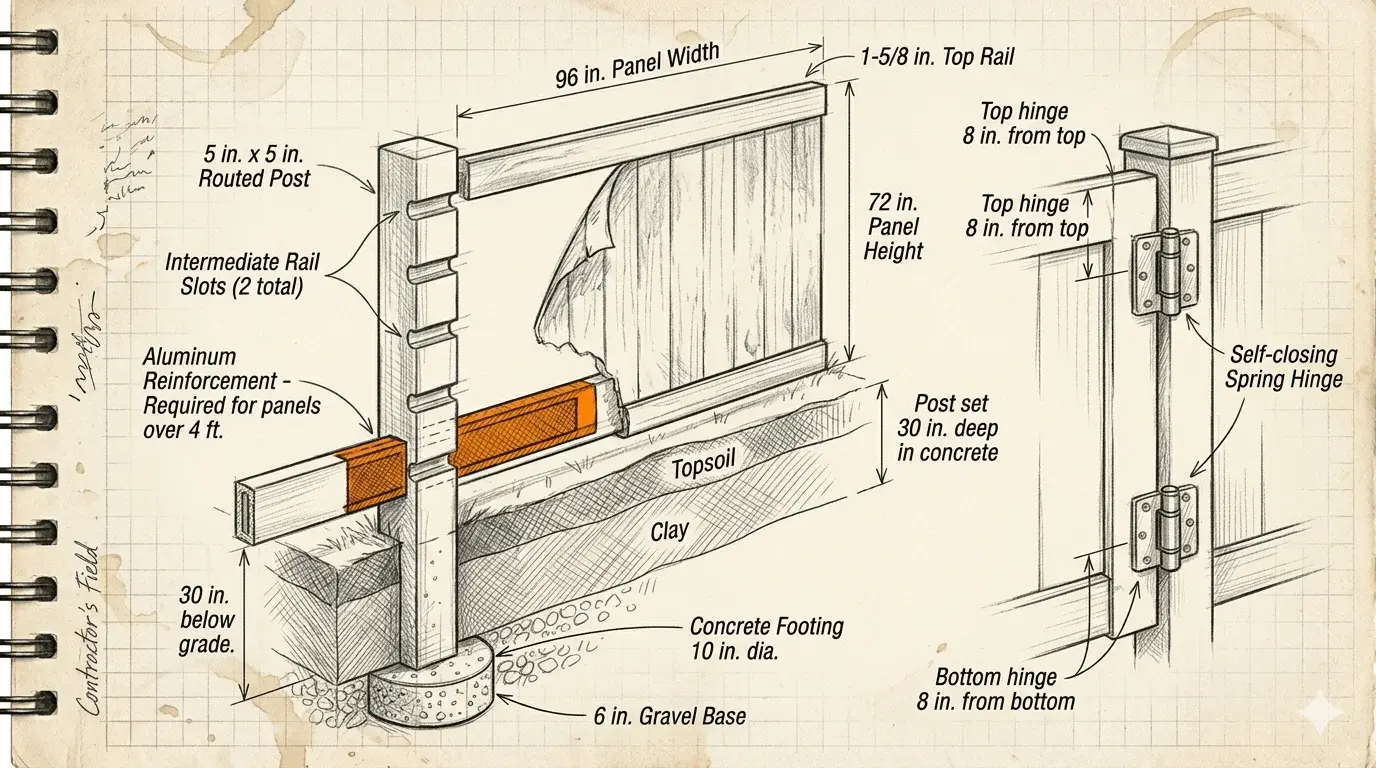
The standard rule: hole diameter should be 10 inches minimum for a 5" x 5" post. That gives you 2.5 inches of concrete on each side. For 4" x 4" posts, a 10-inch hole still works and provides even more concrete coverage.
Depth follows a simple formula:
Post hole depth = one-third of total post length + 6 inches for gravel base
For a 6-foot fence with an 8-foot, 9-inch post (105 inches total), that means:
- One-third of 105 inches = 35 inches
- Plus 6 inches of gravel = 41 inches total hole depth
- That leaves 64 inches above grade, which accommodates the 72-inch panel height with the bottom rail sitting 2 inches above grade and the post cap adding the rest
In frost-prone regions, your local code may require the bottom of the post hole to sit below the frost line. In the northern United States, frost lines range from 36 inches (southern Ohio, Kentucky) to 60 inches (northern Minnesota, Wisconsin). Always check local building codes. A fence that heaves out of the ground in its first winter is a callback you cannot bill for.
| Fence Height | Total Post Length | Hole Depth (1/3 + 6") | Above-Grade Post Height | Hole Diameter |
|---|---|---|---|---|
| 4 ft | 84" (7 ft) | 34" | 50" | 10" |
| 5 ft | 96" (8 ft) | 38" | 58" | 10" |
| 6 ft | 105" (8 ft 9 in) | 41" | 64" | 10" |
| 8 ft | 132" (11 ft) | 50" | 82" | 12" |
Step 3: Setting Posts in Concrete
Pour 4 to 6 inches of pea gravel into the bottom of each hole before placing the post. This gravel layer serves two purposes: it provides drainage so water does not pool at the base of the post, and it gives you a few inches of adjustment room for final height.
Concrete Mix and Pour
Use premixed concrete, either the fast-setting type (sets in 20 to 40 minutes) or standard mix. Fast-setting concrete lets your crew attach rails the same day. Standard mix requires 24 to 48 hours of cure time before loading the posts.
For a 10-inch diameter hole that is 35 inches deep (after gravel), you will need approximately 1.5 fifty-pound bags of premixed concrete per post. For 12-inch holes at 44 inches deep, budget 2 to 2.5 bags per post.
Pour the dry mix into the hole around the post. Add water according to the bag instructions, typically 1 gallon per 50-pound bag. Some contractors prefer to alternate layers: pour half the dry mix, add half the water, then repeat. This method reduces air pockets and voids in the concrete.
Getting Posts Plumb and Level
Strap a post level to the post on two adjacent sides. Adjust until both bubbles read level. Brace the post with 2x4 kickers staked into the ground at 45-degree angles from two sides. Do not remove braces until the concrete has fully set.
Check the height of each post against your string line as you set it. The top of every post in a straight run should align within 1/8 inch. On a grade, maintain consistent reveal above each panel. Measure down from the string line to confirm.
Set corner posts and end posts first. Let them cure. Then run a string line between them at the exact post-top height. Set all intermediate (line) posts to this string. This sequence eliminates cumulative error.
Step 4: Attaching Rails and Panels
Vinyl fence systems use a rail-and-panel assembly that slides together. The exact method varies by manufacturer, but the general sequence is consistent.
Bottom Rail First
The bottom rail installs first. Most systems use a routed slot in the post where the rail end slides in. Insert the rail into the first post, then slide the other end into the adjacent post. The rail should sit 2 inches above finished grade. This gap prevents soil contact, which causes staining and gives insects a pathway.
Some manufacturers use mounting brackets instead of routed posts. In that case, screw the bracket to the inside of the post at the correct height, then snap or slide the rail into the bracket. Use stainless steel or exterior-grade screws. Never use drywall screws. They rust within months and leave orange streaks down your white vinyl.
Panel Insertion
With the bottom rail in place, slide the pickets or privacy panels down into the bottom rail channel from the top. For privacy fence, the panels are typically tongue-and-groove boards that interlock as you slide them in, one at a time. For picket styles, each picket drops into a pre-spaced slot in the rail.
Work from one end to the other. Keep the panels plumb as you insert them. A panel that goes in crooked can jam and crack if forced.
Top Rail
Once all panels or pickets are in the bottom rail, slide the top rail over the top edges. The top rail captures the panels between the two rails. Push the rail ends into the routed post slots or bracket them the same way you did the bottom rail.
For vinyl privacy fence, confirm that every tongue-and-groove joint is fully seated before locking the top rail. A gap of even 1/4 inch between boards will be visible from 20 feet away and the homeowner will notice.
Step 5: Gate Hanging
Gates are the most common failure point on any vinyl fence job. A gate that sags, drags, or will not latch generates more callbacks than every other issue combined. Get this step right.
Gate Post Reinforcement
Gate posts take significantly more lateral force than line posts. For any gate wider than 42 inches, install a galvanized steel or aluminum insert inside the gate post. These inserts run the full buried length of the post plus at least 24 inches above grade. For gates 60 inches (5 feet) or wider, the insert should run the full height of the post.
Use a 12-inch diameter hole for gate posts instead of 10 inches. Add an extra half bag of concrete. The gate post must be absolutely rigid before you hang the gate.
Hinge Placement
Mount hinges at 10 inches from the top of the gate frame and 10 inches from the bottom. For gates taller than 5 feet or wider than 4 feet, add a third hinge centered between the top and bottom hinges. Use self-closing hinges if code requires it (pool enclosures always do, per ASTM F1908 and local amendments).
Pre-drill all hinge holes through the vinyl and into the aluminum insert. Vinyl alone will not hold a screw under gate load. The screws must bite into the metal insert or the gate will pull loose within a year.
Latch Alignment
Hang the gate on the hinges before installing the latch. Close the gate and check the gap between the gate frame and the latch post. It should be 3/8 inch to 1/2 inch, uniform from top to bottom. Adjust hinges if needed.
Mount the latch at 48 inches from grade for residential applications. For pool enclosures, the latch must be at least 54 inches from grade on the pool side, per most local codes based on the International Swimming Pool and Spa Code. Confirm with your local authority having jurisdiction.
Aluminum Inserts: When Required and Why
Aluminum inserts are internal reinforcement sleeves that slide inside hollow vinyl posts. They add rigidity and provide a solid substrate for fastening hardware. Here is when you need them:
- Gate posts: Always. No exceptions. A vinyl gate post without an aluminum insert will flex, shift, and eventually fail. The repeated open-close cycle creates lateral stress that hollow vinyl cannot handle alone.
- End posts: Recommended for fence heights of 5 feet and above. End posts bear the full tension load from one direction with no opposing panel to counterbalance.
- Corner posts: Required when the fence changes direction at angles less than 135 degrees. A 90-degree corner post takes significant lateral force from both directions.
- Line posts in high-wind areas: If the installation is in a region with sustained winds above 50 mph, reinforce every post. Privacy fence acts like a sail. A 6-foot privacy panel in a 60 mph gust generates roughly 14 pounds of force per square foot, which translates to over 500 pounds of lateral load on each 8-foot section.
- Posts taller than 7 feet: Any post exceeding 7 feet above grade needs internal reinforcement to prevent whipping in wind.
NMI supplies aluminum inserts sized to fit standard 4" x 4" and 5" x 5" vinyl post profiles. The insert should extend from 6 inches above the concrete line down to the bottom of the post hole. For gate posts and high-wind applications, extend the insert to within 6 inches of the post top. Check NMI's aluminum rail and insert options for sizing details.
Materials Needed Per 100 Linear Feet
Use this table for estimating material quantities on standard vinyl privacy fence jobs. Adjust for your specific panel width and post size.
| Material | Qty per 100 LF (6-ft panels) | Qty per 100 LF (8-ft panels) | Notes |
|---|---|---|---|
| Vinyl posts (5x5) | 17-18 | 13-14 | Includes 1 extra for cuts/waste |
| Vinyl panels | 16-17 | 12-13 | Based on panel width matching post spacing |
| Top rails | 16-17 | 12-13 | One per panel section |
| Bottom rails | 16-17 | 12-13 | One per panel section |
| Post caps | 17-18 | 13-14 | One per post, buy 2 extra |
| Concrete (50-lb bags) | 26-36 | 20-28 | 1.5-2 bags per post |
| Pea gravel (cubic feet) | 3-4 | 2-3 | 4-6" base per hole |
| Aluminum inserts | 2-4 | 2-4 | Gate posts, end posts, corners |
| Stainless steel screws | 1 box (100 ct) | 1 box (100 ct) | Brackets, hinges, hardware |
| Gate kit (single gate) | 0-2 | 0-2 | Includes hinges, latch, drop rod if double |
Cold Weather Installation Tips
PVC becomes noticeably more brittle below 40 degrees Fahrenheit. At 20 degrees, it can crack from impacts that would cause no damage at 70 degrees. If you are installing vinyl fence in cold weather, adjust your methods.
- Store materials in a heated space overnight. Bring panels, rails, and posts to 50 degrees or warmer before working with them. A heated trailer or garage works. If materials have been sitting on a cold truck bed for hours, do not force any connections.
- Do not use a hammer on cold vinyl. Use a rubber mallet only, and strike gently. Even a rubber mallet can crack a frozen panel edge. If a panel will not seat, warm the connection point with a heat gun at low setting (250 to 300 degrees) for 15 to 20 seconds.
- Expand your concrete cure time. Fast-setting concrete that claims a 20-minute set time at 70 degrees may take 60 to 90 minutes at 35 degrees. Standard concrete may need 72 hours or more below 40 degrees. Do not load posts with panels until you are confident the concrete has cured.
- Allow for thermal expansion. Vinyl expands and contracts with temperature changes at a rate of approximately 3/8 inch per 10-foot section over a 50-degree temperature swing. If you install panels tight in 25-degree weather, they may buckle in July when temperatures hit 95 degrees. Leave a 1/4-inch gap at each rail-to-post connection point during cold weather installs.
- Frozen ground. If the ground is frozen to a depth of more than 8 inches, a manual post hole digger will not cut it. Use a power auger with a carbide-tipped bit, or postpone the job. Forcing a standard auger into frozen ground can damage the equipment and produce rough, oversized holes.
Common Mistakes Contractors Make
These are the errors that experienced wood and chain-link contractors make on their first vinyl jobs. Every one of them leads to callbacks, warranty claims, or both.
1. Post Spacing Does Not Match Panel Width
Wood fence allows you to adjust board placement to cover small spacing errors. Vinyl does not. If your posts are 73 inches apart and the panel is 72 inches wide, the panel will rattle in the wind. If they are 71.5 inches apart, the panel will not fit at all. Measure twice. Then measure again.
2. Skipping the Gravel Base
Without a gravel drainage layer at the bottom of the hole, water sits against the concrete and the post base. Over freeze-thaw cycles, this water expands and can crack the concrete footing or heave the post upward by 1 to 2 inches. That heave creates a visible gap under the panel that the homeowner will call about.
3. Using Wood Fence Post-Setting Techniques
Wood posts can be tamped in with gravel alone in some applications. Vinyl posts cannot. Vinyl has no structural rigidity without the concrete anchor. Every vinyl post gets concrete. Period.
4. Cutting Vinyl with a Standard Wood Blade
A 24-tooth framing blade will chip and crack PVC. Use an 80-tooth fine carbide blade, or even better, reverse a standard plywood blade so the teeth cut backwards. The reversed blade melts through the vinyl cleanly rather than chipping it. Some contractors prefer a 10-inch blade with 60 or more teeth.
5. Not Reinforcing Gate Posts
Already covered above, but it bears repeating. A hollow vinyl gate post will fail. It is not a question of if but when. Install the aluminum insert and save yourself the callback.
6. Setting All Posts Before Checking Panel Fit
Set your first two posts, let the concrete stiffen for 20 minutes (fast-set) or brace them firmly, then dry-fit one panel. Confirm the panel drops in cleanly, the rails seat properly, and the height is correct. If something is off, you can adjust two posts. Adjusting seventeen posts after the concrete has cured is a nightmare.
7. Ignoring the Property Survey
Vinyl fence removal is not like pulling a wood fence. The concrete footings are substantial (10-inch diameter, 35 to 41 inches deep), and the posts are often cemented in permanently. Removing and relocating a vinyl fence that encroaches on a neighbor's property costs nearly as much as the original installation. Start every job at the property pins.
Working with Different Vinyl Fence Styles
Not all vinyl fence installations follow the same assembly method. The process described above applies primarily to privacy fence with tongue-and-groove panels. Other styles have variations worth noting.
Picket fence (36" to 48" height): Individual pickets drop into routed rails from the top. Spacing is typically 3.5 inches between pickets, but verify with the product specs. Picket fence uses smaller posts (4" x 4") and shallower holes (24" to 30" depth). Wind load is significantly lower due to air flow between pickets.
Semi-privacy fence: Features alternating boards with 1-inch gaps or lattice top panels. Install the solid lower section like privacy fence, then attach the lattice top panel using manufacturer-supplied brackets. Lattice panels are fragile. Handle them flat, never on edge.
Ranch rail (2-rail, 3-rail, 4-rail): Posts are spaced at 8-foot intervals with horizontal rails only, no panels. Rails slide into routed holes in the posts. Some systems use a snap-fit bracket. Ranch rail installs faster than any other vinyl style because there are fewer components per linear foot. A two-person crew can complete 250 to 300 linear feet per day. Browse NMI's full vinyl fence lineup for ranch rail, privacy, and picket profiles.
Stepping and Racking on Slopes
When the grade changes along the fence line, you have two options: stepping (stair-step pattern) or racking (angling the panels to follow the slope).
Stepping is the standard approach for privacy fence. Each panel sits level, with the bottom of the next panel stepping down (or up) to follow the grade. The step height between adjacent panels should not exceed 6 inches. If the grade drops more than 6 inches per panel width, you may need to use shorter panels for transition sections.
Racking is available on certain picket and semi-privacy styles where the pickets can pivot within the rail. The rails angle to follow the grade while the pickets stay vertical. Most vinyl picket fence can rack up to a 15-degree slope (roughly a 1-foot rise over an 8-foot run). Beyond that angle, stepping is required.
On slopes steeper than 25 degrees (approximately 2 feet of rise per 8 feet of run), consider terracing with retaining walls and installing fence on the flat sections. Steep-slope vinyl installations put excessive lateral pressure on the downhill posts and can lead to leaning within 2 to 3 years.
Inspection and Final Walkthrough
Before calling the customer for final inspection, run through this checklist:
- All posts plumb within 1/4 inch over 6 feet (use a 6-foot level)
- All panels level (check with a 4-foot level across the top rail)
- All post caps glued and seated flush
- All gates swing freely, latch securely, and self-close if required by code
- No visible concrete above grade (scrape or bury it)
- No scuff marks or dirt on panels (clean with mild soap and water)
- Bottom rail gap is consistent at 2 inches above grade
- No gaps between tongue-and-groove boards greater than 1/16 inch
Hand the homeowner the manufacturer's warranty card and care instructions. Vinyl fence requires minimal maintenance, but the homeowner should know to clean it annually with a garden hose and to avoid parking lawn equipment against the panels.
Frequently Asked Questions
How deep should vinyl fence post holes be?
The standard depth is one-third of the total post length plus 6 inches for a gravel drainage base. For a typical 6-foot privacy fence with a 105-inch post, that works out to about 41 inches deep. In frost-prone areas, verify that this depth meets or exceeds your local frost line requirement, which ranges from 36 inches in the mid-South to 60 inches in northern states.
Do all vinyl fence posts need concrete?
Yes. Unlike wood posts, which can sometimes be set with compacted gravel alone, vinyl posts have no structural rigidity without a concrete footing. The concrete provides the lateral resistance that keeps the post upright. Use 1.5 to 2 bags of 50-pound premixed concrete per post, depending on hole diameter and depth.
Can you install vinyl fence in winter?
You can, but PVC becomes brittle below 40 degrees Fahrenheit. Store materials in a heated space overnight, use a rubber mallet only (never a hammer), and allow extra cure time for concrete. Leave 1/4-inch expansion gaps at rail connections because panels installed tight in cold weather will buckle when summer temperatures arrive. Avoid installation below 20 degrees entirely.
When do you need aluminum inserts in vinyl fence posts?
Aluminum inserts are required in all gate posts, recommended for end posts on fences 5 feet or taller, and necessary for corner posts at angles under 135 degrees. In high-wind regions with sustained speeds above 50 mph, reinforce every post. The insert adds structural rigidity, prevents post flex, and provides a solid substrate for mounting gate hinges and latches.
What is the correct post spacing for vinyl fence?
Post spacing must match your panel width exactly, plus the width of one post. For a 72-inch (6-foot) panel with a 5-inch post, on-center spacing is approximately 77 inches. Even a half-inch error will cause problems, as panels that are too tight will not seat, and panels that are too loose will rattle in wind. Always dry-fit a panel between the first two posts before committing to the full layout.