
Pool Fence Regulations: What Every Contractor Needs to Know in 2026
A 4-year-old can drown in under 2 minutes. That single statistic drives every pool fence regulation on the books, and it is the reason code enforcement officers measure your picket spacing with a 4-inch test sphere before signing off on a final inspection. If you install pool barriers, you need to know ASTM F1908, the ICC/ANSI barrier codes, and the local amendments that can turn a compliant install into a failed one. This guide breaks down the federal standards, the most common state and municipal variations, and the inspection checklist you should run before you call for sign-off.
The Two Standards That Govern Pool Barriers
Pool fence requirements in the United States trace back to two primary documents. The first is ASTM F1908, "Standard Guide for Residential Pool Safety Covers and Barriers." The second is the International Swimming Pool and Spa Code (ISPSC), which references ICC/ANSI standards and is adopted (with local amendments) by most jurisdictions. Understanding where these overlap, and where they diverge, is the difference between a one-trip inspection and a callback.
ASTM F1908 Overview
ASTM F1908 was last revised in 2021 and provides the baseline performance criteria for pool barriers. It covers fences, walls, gates, and doors that serve as part of the barrier envelope around residential swimming pools, spas, and hot tubs. The standard does not prescribe specific materials. It sets performance thresholds: minimum height, maximum openings, gate hardware behavior, and climbability resistance. A chain link fence and a vinyl fence can both comply, provided they meet the dimensional and functional requirements.
ICC/ANSI and the ISPSC
The International Code Council publishes the ISPSC, which most building departments adopt as their base pool code. Chapter 3 of the ISPSC covers barriers. It aligns closely with ASTM F1908 but adds prescriptive detail that ASTM leaves to the installer's judgment. For example, the ISPSC specifies that horizontal members on the pool side of a fence must be spaced at least 45 inches apart to prevent climbing, a detail ASTM addresses in performance language rather than hard numbers.
Most jurisdictions layer local amendments on top of the ISPSC. Florida requires a 48-inch minimum barrier height but also mandates alarms on all doors providing direct pool access. Arizona allows a property wall to serve as one side of the barrier if it meets height and non-climbability requirements. California requires pool barriers to comply with Section 115922 of the Health and Safety Code, which adds specific latch-height requirements for gates. Always pull the local code before you price a job.
Minimum Height Requirements
The baseline minimum height for a pool barrier fence is 48 inches, measured on the side facing away from the pool. That 48-inch number comes from both ASTM F1908 and the ISPSC. But "48 inches" is not universal.
| Jurisdiction / Standard | Minimum Barrier Height | Notes |
|---|---|---|
| ASTM F1908 (Federal Baseline) | 48" | Measured from finished grade on exterior side |
| ISPSC / ICC (Model Code) | 48" | Same measurement point as ASTM |
| Florida (FBC Chapter 4) | 48" | Door alarms required on all direct-access doors |
| California (HSC 115922) | 60" | Applies to new construction; retrofits may follow 48" with approved alarms |
| Arizona (AAC R18-5-224) | 60" | Property walls count if they meet non-climbability requirements |
| New York (Residential Code) | 48" | Local municipalities may add requirements |
| Texas (Local Adoption) | 48" | Varies by municipality; Houston requires 48", some HOAs require 60" |
| Oregon (OAR 333-060) | 48" | Public pools require 60"; residential follows 48" |
Notice the split. Most states follow the 48-inch baseline. California and Arizona push to 60 inches, and several municipalities within 48-inch states have adopted 60-inch requirements through local ordinance. Before you order materials, confirm the height requirement with the local building department. A 6-foot privacy slat installation in chain link will clear any height code on the books, but a standard 4-foot residential panel may fall short in a 60-inch jurisdiction by a full 12 inches.
Key Pool Fence Requirements at a Glance
The following table consolidates the core dimensional and functional requirements from ASTM F1908 and the ISPSC. Use this as your quick-reference during estimating and layout.
| Requirement | Standard / Specification | Common Value |
|---|---|---|
| Minimum barrier height | ASTM F1908, ISPSC Ch. 3 | 48" (60" in CA, AZ, some local codes) |
| Maximum gap between pickets/mesh openings | ASTM F1908 Section 6 | 4" or less (cannot pass a 4" sphere) |
| Maximum gap at bottom of fence | ISPSC 305.3 | 2" maximum from grade to bottom rail |
| Gate operation | ASTM F1908, ISPSC 305.4 | Self-closing, self-latching |
| Gate swing direction | ISPSC 305.4 | Must open away from pool |
| Gate latch height (no lock) | ISPSC 305.4 | 54" minimum from grade on pool side |
| Gate latch height (with lock) | ISPSC 305.4 | May be lower if key-lockable |
| Horizontal rail spacing (climbability) | ISPSC 305.2 | 45" minimum between climbable horizontals on pool side |
| Non-climbable zone | ASTM F1908 | No footholds or handholds within barrier surface |
| Distance from pool edge | ISPSC 305.1 | 20" minimum setback from water's edge |
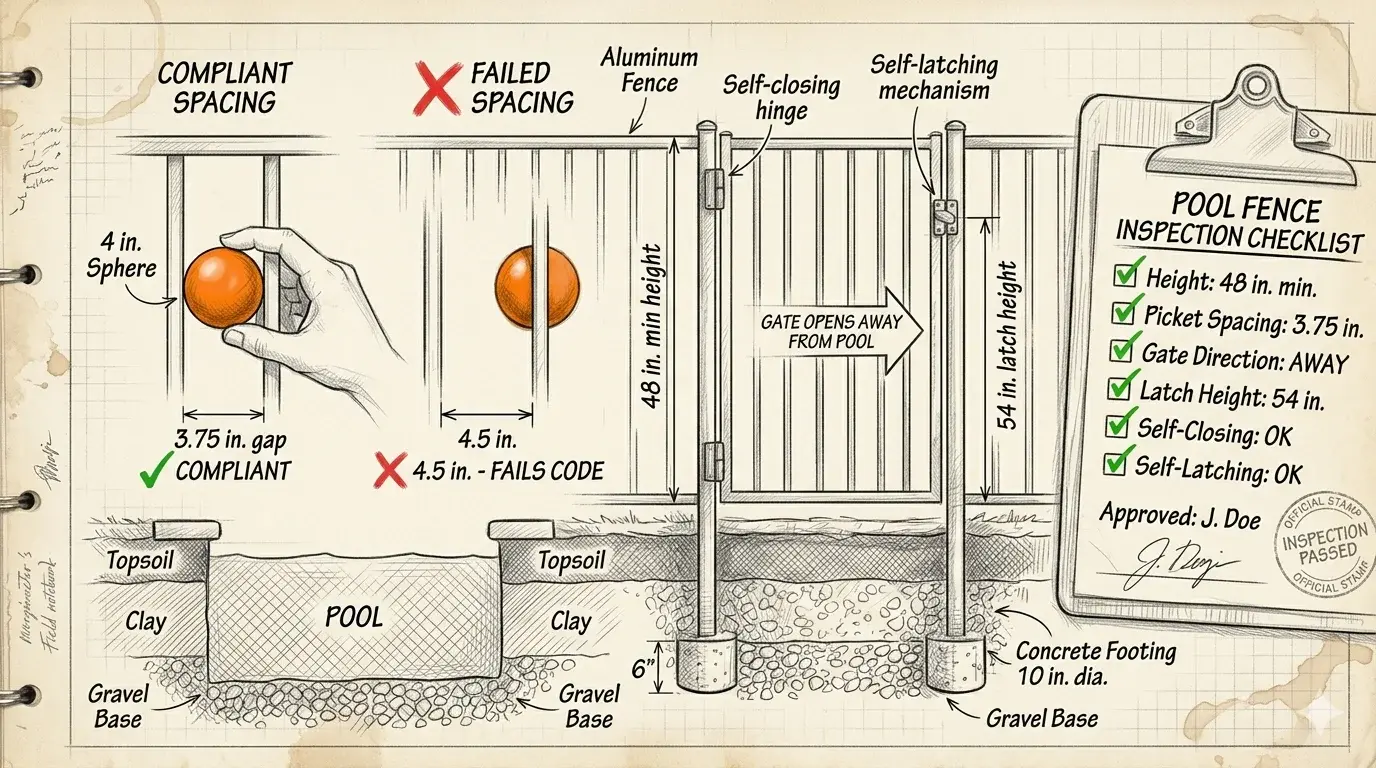
The 4-inch sphere test is the single most common reason pool fence inspections fail. An inspector will attempt to pass a rigid 4-inch-diameter sphere through any opening in the barrier. If the sphere passes through, the fence fails. This applies to picket spacing in aluminum fence and rail, mesh openings in chain link, and any decorative cutouts in vinyl panels.
Picket Spacing and the 4-Inch Sphere Rule
The logic behind the 4-inch rule is straightforward: a small child's head measures approximately 5 inches in diameter, and a 4-inch body can follow where a head can fit. By limiting openings to less than 4 inches, the barrier prevents a child from squeezing through.
For picket-style fences, this means on-center spacing of approximately 3-7/8 inches, depending on picket width. A standard 5/8-inch aluminum picket at 3-7/8-inch on-center spacing produces a clear gap of 3-1/4 inches. That passes. A 3/4-inch picket at 4-3/4-inch on-center spacing produces a 4-inch clear gap. That fails.
For chain link, the mesh size determines compliance. Standard 2-inch diamond mesh (measured corner to corner diagonally) has an opening of approximately 2-3/8 inches. That passes easily. However, if the fabric is stretched loosely or damaged, the diamonds can distort and exceed 4 inches. Tension matters. A properly stretched chain link fence with 2-inch mesh will never fail the sphere test. A slack one might.
Vinyl privacy fences with solid panels have zero gap between boards. They pass by default. Vinyl semi-privacy styles with spacing between boards must maintain sub-4-inch gaps. Check the manufacturer's spec sheet before committing to a semi-privacy style for a pool barrier application.
Gate Requirements: Self-Closing, Self-Latching, Direction of Swing
Gates are where most pool fence installations get complicated, and where most inspections fail. The code requirements for pool barrier gates are non-negotiable and specific.
Self-Closing
Every gate in a pool barrier must close automatically from any open position. "Any open position" means from fully open (typically 90 degrees), from 6 inches ajar, and from every angle in between. Spring hinges are the most common solution. Hydraulic closers work but add cost ($45-$85 per unit vs. $12-$25 for spring hinges). Magnetic latches alone do not satisfy the self-closing requirement because they only engage when the gate is within 1-2 inches of the closed position.
Test the self-closing mechanism by opening the gate to 90 degrees and releasing it. It must swing fully closed and engage the latch without manual assistance. Wind, grade, and hinge friction all affect performance. Adjust spring tension on-site. A gate that closes in a showroom may not close on a 2% grade with a 10 mph crosswind.
Self-Latching
The latch must engage automatically when the gate closes. No manual latching. The latch release mechanism on the pool side must be at least 54 inches above the ground or the walking surface below the latch. On the exterior side, the latch can be at any height. If the gate has a lock (keyed or combination), the 54-inch height requirement is waived for the release mechanism, but the lock must be engaged to substitute for height compliance. Most inspectors will test the latch height with a tape measure. Be precise.
Direction of Swing
Pool barrier gates must swing outward, away from the pool. This prevents a child who has reached the gate from pushing it open toward the water. The hinge orientation determines swing direction. When you are standing inside the pool area looking at the gate, the gate should swing toward you (i.e., you pull it open from the pool side). When standing outside looking in, you push the gate open.
Double gates follow the same rule. Both leaves must swing away from the pool. Drop rods and cane bolts on the inactive leaf must also self-engage. An inactive leaf that can be pushed open toward the pool by a child defeats the barrier.
Mesh vs. Picket vs. Glass: Comparing Pool Barrier Materials
Contractors frequently get asked which fence type is "best" for a pool barrier. The answer depends on the customer's budget, aesthetics, and the site conditions. Here is how the three main categories compare.
| Criteria | Chain Link Mesh | Aluminum/Steel Picket | Tempered Glass Panels |
|---|---|---|---|
| Installed cost per linear foot | $15 - $30 | $30 - $65 | $150 - $400 |
| Typical height | 48" - 72" | 48" - 60" | 48" - 60" |
| 4" sphere test compliance | Yes (2" mesh standard) | Yes (if pickets spaced correctly) | Yes (solid panels) |
| Climbability resistance | Low (mesh provides footholds) | High (vertical pickets only) | Very high (smooth surface) |
| Visibility / sightlines to pool | Good | Good | Excellent |
| Wind load resistance | Excellent (open mesh) | Very good | Moderate (solid surface catches wind) |
| Maintenance | Low (galvanized) to moderate (vinyl-coated) | Low (powder-coated aluminum) | Moderate (cleaning, hardware checks) |
| Lifespan | 15 - 25 years | 25 - 40+ years | 20 - 30 years (hardware dependent) |
| Code-compliant gate options | Widely available | Widely available | Limited, custom-fabricated |
| Best application | Budget installs, rentals, commercial | Residential, HOA-governed properties | Luxury residential, resorts |
A Note on Climbability
Chain link mesh presents a climbability issue for pool barriers. The diamond pattern provides obvious footholds. Some jurisdictions will reject chain link for pool barriers outright unless combined with privacy slats that eliminate the footholds. Others accept chain link if it meets height requirements, reasoning that the barrier's purpose is to delay unsupervised access, not to be unclimbable. Check your local code. If chain link is acceptable, specify a minimum 48-inch height (60 inches in applicable jurisdictions) and use 2-inch mesh with no bottom rail that could serve as a step.
Removable Mesh Pool Fences
Removable mesh pool fences (also called "temporary" pool barriers) are a separate product category. These use fiberglass or aluminum poles set in deck-mounted sleeves, with a tensioned mesh panel between them. They comply with ASTM F2286 (separate from F1908) and are popular for residential pools where homeowners want to remove the barrier when adults are supervising. As a contractor, these are high-margin installs: the sleeve installation is the labor-intensive portion, and the mesh panels are manufacturer-supplied. Typical installed cost runs $15-$25 per linear foot, including sleeves.
Vinyl Fence for Pool Barriers
Solid vinyl fence panels are inherently code-compliant for the sphere test because there are no gaps. The challenge with vinyl is climbability. Horizontal rails on the pool side can serve as footholds. The code requires that any horizontal member on the pool side be either less than 2 inches wide or spaced at least 45 inches from the next climbable component. Most vinyl fence designs place the smooth, flat side facing out (away from the owner's yard), which means the horizontal rails face the pool side if the fence is installed with the "good side" facing the neighbor.
For pool barrier applications, install vinyl fence with the rails facing away from the pool. The smooth side faces the pool area. This eliminates the climbability concern and puts the finished face where swimmers see it. Explain this to the homeowner before installation because it reverses the typical "good neighbor" orientation.
Aluminum Fence for Pool Barriers
Aluminum fence and rail is the most popular material for dedicated pool barriers in residential settings. The vertical picket design is inherently non-climbable. Standard pool-code-compliant aluminum panels come in 48-inch and 54-inch heights with picket spacing that passes the 4-inch sphere test out of the box. The key spec to verify is picket spacing: most manufacturers offer both "residential" spacing (3-1/2 inch to 3-3/4 inch clear gap) and "pool code" spacing (under 3-1/2 inch clear gap, or with additional mid-rail pickets). Always specify pool-code panels. Standard residential panels may have gaps that exceed 4 inches between the bottom rail and the ground if the grade is uneven.
Rack-and-stair panels are available for sloped installations. When the grade changes more than 6 inches over a panel length, the bottom of the panel can lift away from the ground and create a gap exceeding the 2-inch maximum at grade. Use raked panels that follow the slope, or add a bottom rail and trim the pickets to follow grade. Either approach maintains the sub-2-inch gap at the bottom.
Inspection Checklist for Contractors
Run through this checklist before calling for inspection. Every item below is a documented reason for pool fence inspection failures. Catching them before the inspector arrives saves you a return trip and protects your reputation.
- Height verification: Measure barrier height at every post location. Uneven grade can cause a 48-inch fence to measure 44 inches at a low spot. Measure from the exterior finished grade to the top of the fence, not from the interior pool deck.
- Sphere test, every opening: Pass a 4-inch rigid sphere through every opening in the barrier. Check picket gaps, the space under the bottom rail, the space between the fence and any adjacent structure, and the gap between the gate and the gate post.
- Bottom gap: Measure the gap between the bottom of the barrier and finished grade at every post and at mid-span. Maximum 2 inches. Grade settling after post-hole backfill is the most common cause of bottom-gap failures.
- Gate self-closing test: Open the gate to 90 degrees and release. It must swing fully closed and the latch must engage without assistance. Test from multiple open positions: 90 degrees, 45 degrees, and 6 inches ajar.
- Gate self-latching test: Confirm the latch engages automatically every time the gate closes. Operate the gate 10 times. If the latch fails to engage even once, adjust or replace the hardware.
- Latch height: Measure the latch release mechanism height on the pool side of the gate. Must be 54 inches minimum above grade unless the gate has a key lock or combination lock.
- Gate swing direction: Stand on the pool side. Push the gate. If it opens toward the pool, the swing is wrong. The gate must open away from the pool.
- Climbability audit: Walk the pool side of the entire barrier. Look for horizontal rails, decorative elements, tree branches within 4 feet, furniture, or equipment that could serve as a climbing aid. The code requires that no climbable feature exist on the pool side within the barrier zone.
- Adjacent structures: Check where the fence meets the house, a retaining wall, or another structure. There should be no gap greater than 4 inches at these connection points. Use filler panels, wall mounts, or return sections to close gaps.
- Equipment access: Verify that pool equipment (pumps, filters, heaters) located outside the barrier does not create a climbable surface adjacent to the fence. Equipment pads within 3 feet of the barrier can allow a child to climb onto the equipment and over the fence.
- Permanent attachment: Confirm the barrier is permanently installed. Posts must be set in concrete or mechanically fastened. Freestanding barriers, weighted bases, or temporary fencing (unless ASTM F2286 compliant removable mesh) will not pass inspection for a permanent pool barrier.
Common Mistakes Contractors Make with Pool Fences
Relying on the Pool Builder's Survey
Pool builders provide a site plan that shows the proposed barrier location. That plan was drawn before excavation. After the pool is dug, graded, and decked, the actual grades rarely match the original survey. Re-measure everything after the pool deck is poured and the finish grade is established. A 3-inch grade change can drop your 48-inch fence below minimum height.
Using Residential-Grade Hardware on Gates
Standard gate hinges and latches from the hardware store are not designed for pool-code compliance. They lack the self-closing spring force, the self-latching mechanism, or the 54-inch release height. Use purpose-built pool-code gate hardware. Magna-Latch (54-inch top-pull) and TruClose (self-closing hinges) are the two most widely accepted brands. Budget $60-$120 per gate for compliant hardware, compared to $15-$30 for standard hardware.
Ignoring the House Wall as Part of the Barrier
When a pool fence terminates at the house, the house wall becomes part of the barrier. Any door or window in that wall that provides direct access to the pool area must have a compliant self-closing, self-latching device or an audible alarm. Sliding glass doors need a secondary latch at 54 inches or a UL-listed door alarm. Casement windows within 48 inches of grade that open large enough to pass a child must be permanently fixed or alarmed. Communicate this to the homeowner during the estimating phase. It is their responsibility, but if they do not address it, the pool barrier inspection fails, and you get the phone call.
Forgetting About Removable Sections
Some homeowners request removable fence panels for equipment access or large-item delivery. The code allows removable sections only if they require a tool for removal and are secured with fasteners that cannot be opened by hand. A panel held in place by drop pins or friction clips does not comply. Bolt-on brackets with tamper-resistant fasteners are the correct approach. Specify stainless steel hardware in pool environments to prevent corrosion.
State-by-State Variations Worth Knowing
While we cannot cover all 50 states here, the following variations come up most often in contractor conversations.
Florida: The Virginia Graeme Baker Pool and Spa Safety Act applies federally to drain covers, but Florida layers on additional requirements. All doors from the home to the pool must have self-closing devices and alarms. The alarm must produce a sound of at least 85 decibels at 10 feet. Window openings within 48 inches of the floor that provide direct access must be equipped with a latch at 54 inches or a fixed screen.
California: The 60-inch height requirement is the biggest differentiator. California also requires at least one of seven approved safety features for residential pools: a fence, cover, exit alarm, self-latching door device, removable mesh fence, or combination thereof. New pool construction requires a minimum of two features.
Texas: The state defers to municipal adoption. Houston, Dallas, Austin, and San Antonio all follow the ISPSC with minimal amendments. Rural areas may have no pool barrier code at all. Always confirm with the permitting office.
Arizona: The 60-inch barrier height and 5-inch maximum picket spacing (more restrictive than the 4-inch standard) apply in Maricopa County. The county also prohibits chain link as a pool barrier material in residential zones. This is a local amendment, not a state-level requirement, but it covers the Phoenix metro area where most pool installations occur.
Frequently Asked Questions
Can I use a wood fence as a pool barrier?
Yes, wood fence can serve as a pool barrier if it meets all dimensional requirements. Board spacing must not exceed 4 inches, the minimum height must meet local code (48 or 60 inches), and the bottom gap must stay under 2 inches. Horizontal rails must face away from the pool side to prevent climbing. Treat or seal wood in pool-adjacent installations to resist chlorine-related moisture damage.
Do above-ground pools need barrier fences?
If the pool wall height is at least 48 inches and the ladder or steps are removable or lockable, many jurisdictions accept the pool wall itself as the barrier. However, if the pool wall is below 48 inches or a permanent deck provides access, a separate barrier fence is required. Deck-mounted barriers must enclose the access point, and the gate from the deck to the pool ladder must meet self-closing, self-latching requirements.
What happens if a pool fence fails inspection?
The inspector issues a correction notice specifying the deficiencies. You have a set period (typically 14-30 days, depending on jurisdiction) to make corrections and schedule a re-inspection. In most jurisdictions, the first re-inspection is included in the permit fee. Subsequent re-inspections carry additional fees of $50-$150 each. Repeated failures can result in a stop-work order on the pool project.
Are there specific requirements for pool fence gates with pet doors?
Pet doors installed in pool barrier fences or gates must not create an opening that exceeds the 4-inch sphere test. Most standard pet doors have flap openings of 7 to 15 inches, far exceeding the maximum. A pet door in a pool barrier gate will fail inspection in virtually every jurisdiction. The only compliant approach is a self-closing, self-latching pet door with a rigid cover that locks when not in use and cannot be pushed open by a child.
How far from the pool does the fence need to be?
The ISPSC requires a minimum 20-inch setback from the water's edge to the barrier. This setback prevents a child who climbs over the barrier from landing directly in the water. In practice, most installations are set back 36 to 48 inches from the pool coping to allow room for maintenance access and to avoid interference with the pool deck drainage slope. Some jurisdictions require the barrier to be set back far enough to exclude all pool equipment (pumps, heaters, filters) from the pool side.