HDPE Shade Fabric: The Complete Guide for Contractors and Installers
A black 90% HDPE shade cloth installed over a parking lot in Phoenix, Arizona will drop the surface temperature of the asphalt by 30 to 40 degrees Fahrenheit on a July afternoon. That is the difference between a car interior hitting 170 degrees and staying closer to 130 degrees. For the property owner, it is the difference between a parking lot people avoid and one they actively seek out. For you as a contractor, it is a product with strong margins, fast installation, and repeat business from commercial clients who see the results immediately.
HDPE stands for high-density polyethylene, a thermoplastic polymer with a density range of 0.93 to 0.97 grams per cubic centimeter. When knitted into shade cloth, it creates a lightweight, UV-resistant fabric that blocks a precisely controlled percentage of sunlight. This guide covers everything a contractor needs to know to specify, sell, and install HDPE shade fabric, from shade percentages and material comparisons to wind load calculations and attachment methods.
What HDPE Shade Cloth Is and How It Works
HDPE shade cloth is not woven like traditional fabric. It is knitted from flat or round monofilament HDPE tape on a raschel knitting machine. This knitted construction gives the cloth three properties that woven fabrics lack:
- Ravel resistance: You can cut HDPE shade cloth anywhere without the edges unraveling. Woven fabrics fray when cut between threads. This makes field cutting and custom sizing practical.
- Dimensional stability: The knitted structure stretches slightly under load (2% to 4%) and returns to shape. Woven materials tend to sag permanently once stretched.
- Airflow: Even at 90% shade ratings, knitted HDPE allows air to pass through the openings between strands. This ventilation reduces wind load and prevents heat buildup underneath, unlike solid tarps or polycarbonate panels that trap hot air.
The "shade percentage" is the amount of sunlight the fabric blocks. A 70% shade cloth blocks 70% of direct sunlight and transmits 30%. The shade percentage is determined by the density of the knit, specifically how tightly the HDPE strands are packed together.
Shade Percentage Explained
Choosing the right shade percentage is the most important decision in any shade cloth project. Too little shade and the product underperforms. Too much shade and you create a dark, damp environment that promotes mold growth and prevents plants from photosynthesizing.
| Shade % | Light Blocked | Light Transmitted | Best Applications | Temperature Reduction |
|---|---|---|---|---|
| 30% | 30% | 70% | Light-loving crops (tomatoes, peppers), construction dust screens, light wind breaks | 8-12°F |
| 40% | 40% | 60% | Nurseries (sun plants), outdoor event tents where brightness is desired, greenhouse roofs in northern climates | 12-18°F |
| 50% | 50% | 50% | General agriculture, livestock shade, outdoor dining areas, playground equipment shade | 15-22°F |
| 60% | 60% | 40% | Orchid nurseries, shade-loving plants, dog kennels, car dealership lots | 18-25°F |
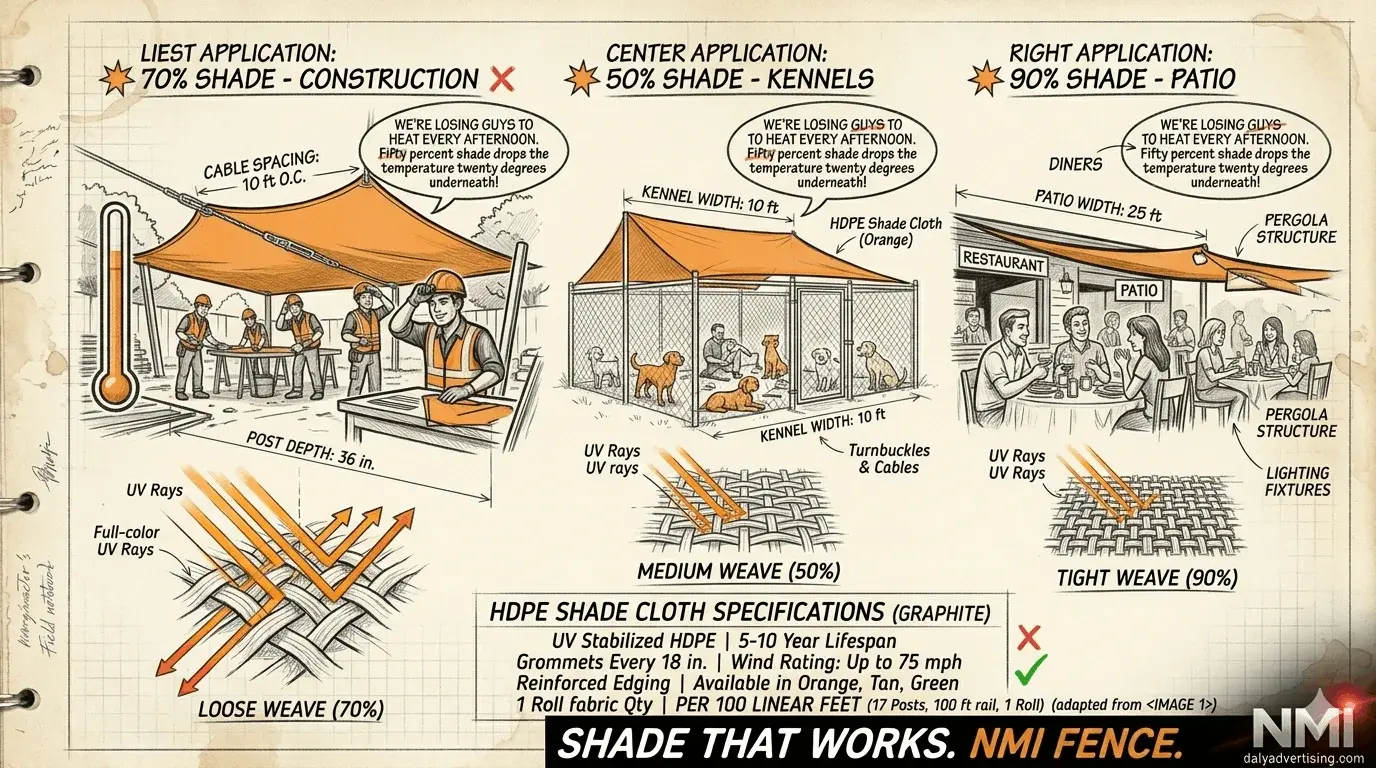
| 70% | 70% | 30% | Parking structures, patios, pool areas, outdoor workshops, construction site screening | 22-30°F |
| 80% | 80% | 20% | Residential privacy screening, tennis courts, heavy shade gardens, equipment protection | 28-35°F |
| 90% | 90% | 10% | Maximum privacy, parking lot canopies, industrial screening, wind/dust barriers | 30-40°F |
A practical rule of thumb: for human comfort in outdoor spaces, 50% to 70% shade is the sweet spot. Below 50%, people still feel uncomfortably hot in direct sunlight. Above 80%, the area starts to feel dark and enclosed, which can deter customers at commercial venues like restaurants and retail centers.
For agricultural applications, match the shade percentage to the crop's light requirements. Leafy greens (lettuce, spinach, herbs) thrive under 40% to 50% shade. Orchids and ferns prefer 60% to 70%. Full-sun crops like tomatoes should not exceed 30% shade or fruit production drops significantly.
UV Stabilization and Lifespan
Raw HDPE degrades under UV exposure. Within 6 to 12 months of constant sun exposure, unstabilized HDPE becomes brittle and tears. UV stabilizers are additives mixed into the HDPE resin before extrusion that absorb ultraviolet radiation and convert it to heat, preventing molecular chain breakdown.
The quality and quantity of UV stabilizer determine the fabric's lifespan. Standard commercial-grade HDPE shade cloth contains 2% to 3% UV stabilizer by weight and carries a rated lifespan of 5 to 8 years. Premium grades with 3% to 5% UV stabilizer last 8 to 10 years, sometimes longer in moderate climates with lower UV indices.
Lifespan is also affected by:
- Geographic location: Shade cloth in Tucson, Arizona (UV index 10-11 in summer) degrades 30% to 50% faster than the same cloth in Seattle, Washington (UV index 6-7). A product rated for 8 years in the Pacific Northwest may last only 5 years in the desert Southwest.
- Orientation: Horizontally mounted shade cloth receives more direct UV exposure than vertically mounted screens. Vertical installations on fence lines or building sides can last 20% to 30% longer.
- Color: Darker colors (black, dark green) absorb more UV energy and heat, which can slightly accelerate degradation compared to lighter colors (white, beige, tan). However, darker colors also provide higher effective shade because they absorb rather than reflect the light.
- Tension: Over-tensioned fabric cannot flex in wind, which concentrates stress at attachment points and grommets. Under-tensioned fabric flaps, causing abrasion and fatigue. Proper tension is snug with approximately 1 to 2 inches of deflection per 10 feet of span under moderate wind.
Color Options and Heat Absorption
HDPE shade cloth is available in a range of colors, and color choice is not just aesthetic. It directly affects heat transfer and the quality of light underneath.
- Black: The most common commercial color. Absorbs the most heat (up to 90% of solar radiation at 90% shade). Creates the highest temperature difference between sun and shade. Best for maximum cooling effect. Slight downside: the fabric surface itself gets hot, up to 140 degrees Fahrenheit in direct sun.
- White / Beige: Reflects 40% to 60% of solar radiation rather than absorbing it. The fabric stays cooler to the touch (100 to 110 degrees Fahrenheit in direct sun). The light underneath has a natural, diffused quality. Preferred for outdoor dining, event venues, and architectural applications where reflected light is desirable.
- Green: The standard for agricultural use. Filters light in a spectrum that promotes healthy plant growth. Absorbs slightly less heat than black (75% to 80% of solar radiation). Blends visually with landscaping and natural settings.
- Sand / Desert Tan: Popular in southwestern U.S. markets. Matches adobe and stucco building aesthetics. Heat absorption between white and green (65% to 75%). Good choice for commercial properties where the shade structure should complement the architecture.
- Blue: Specialty color for pool areas and aquatic facilities. Transmits a small amount of blue-tinted light. No functional advantage over other colors. Selected purely for aesthetic preference.
For commercial parking lot installations, black 70% or 90% shade cloth provides the greatest temperature reduction. For restaurant patios, white or beige at 50% to 70% creates a comfortable, well-lit dining environment. Match the color to the client's needs, not just their preference.
HDPE vs. Polypropylene vs. Polyester: Material Comparison
Contractors sometimes encounter polypropylene (PP) and polyester (PET) shade fabrics priced lower than HDPE. Here is why the price difference exists and what it means for your installations.
| Property | HDPE (Knitted) | Polypropylene (Woven) | Polyester (Woven) |
|---|---|---|---|
| UV Resistance | Excellent (5-10 years with stabilizer) | Poor to Fair (2-4 years) | Good (4-6 years with UV coating) |
| Tear Strength | High (knit structure distributes force) | Low (tears propagate along weave lines) | Medium (better than PP, worse than HDPE) |
| Water Behavior | Passes through (does not pool) | Can pool on tightly woven sections | Repels initially, absorbs over time |
| Mold/Mildew Resistance | Excellent (does not absorb moisture) | Fair (absorbs some moisture) | Poor (absorbs moisture readily) |
| Weight (per sq ft at 70%) | 0.8-1.2 oz | 1.0-1.5 oz | 1.5-2.5 oz |
| Cut-Edge Behavior | Does not fray or ravel | Frays immediately; requires binding | Frays; requires heat sealing or binding |
| Typical Cost (per sq ft) | $0.15-$0.35 | $0.08-$0.18 | $0.20-$0.40 |
| Best Use | Commercial, agricultural, long-term installations | Temporary installations, budget residential | Outdoor furniture covers, awning replacements |
The bottom line: for any installation expected to last more than 2 seasons, HDPE is the correct material. Polypropylene may cost half as much per square foot, but it fails in half the time and lacks the dimensional stability for permanent tensioned installations. Polyester has niche applications in waterproof shade sails and awning replacements, but it is heavier, more expensive, and absorbs moisture.
When a client pushes back on HDPE pricing, show them the math. A 1,000-square-foot polypropylene installation at $0.12 per square foot ($120 in materials) replaced every 2.5 years costs $480 in materials over 10 years, plus 4 re-installations at $500 to $800 labor each. That is $2,480 to $3,680 total. The same coverage in HDPE at $0.25 per square foot ($250 in materials) lasts 8 to 10 years with one installation. Total cost: $750 to $1,050. HDPE wins on 10-year cost by 60% to 70%.
Installation Methods
HDPE shade cloth installation falls into four categories based on the attachment system. Each method suits different applications and structural conditions.
Grommet and Cable System
This is the standard for permanent commercial installations over parking lots, patios, and outdoor venues.
- Brass or stainless steel grommets are set every 18 to 24 inches along the fabric edges. Some manufacturers pre-install grommets; others ship the cloth with reinforced hems for field installation.
- A 3/16-inch or 1/4-inch stainless steel cable runs through the grommets along each edge.
- The cable attaches to structural posts or building-mounted brackets using turnbuckles for tensioning.
- Structural posts are typically 4-inch or 6-inch steel pipe, set in concrete footings 36 to 48 inches deep, spaced 15 to 20 feet apart depending on the span.
- Allow for a 2% to 3% sag in the center of the span. A perfectly flat installation puts excessive stress on the grommets and edge reinforcement.
This method supports spans up to 30 feet between posts with intermediate cable supports. For spans over 20 feet, use a ridge cable (center cable running the length of the installation) to prevent excessive sag.
Zip Tie and Fence Attachment
The fastest and lowest-cost installation method. Used for attaching shade cloth to existing chain link fence, pipe frames, or temporary structures.
- UV-resistant zip ties (minimum 50-pound rated, black or green) spaced every 12 to 18 inches along the top rail and every 24 inches along vertical supports.
- Do not use standard indoor zip ties. They degrade in sunlight within 3 to 6 months. UV-rated ties last 3 to 5 years.
- For chain link fence installations, weave zip ties through the mesh and around the shade cloth edge every 12 inches. Alternate between the top rail and 12 inches below to create two lines of attachment.
- This method works for vertical privacy screens, construction site dust barriers, and temporary shade over kennels and livestock areas.
Track and Channel System
Used on retractable shade installations and commercial shade structures with aluminum or steel frames.
- An aluminum C-channel is bolted to the frame. The shade cloth edge, reinforced with a PVC rope welt, slides into the channel.
- The cloth can be slid open and closed along the channel, similar to a curtain on a track.
- Maximum span between channel supports is 12 to 15 feet. Beyond that, the cloth sags between supports and the track binds.
- This system costs 2 to 3 times more than grommet-and-cable but offers adjustability. Popular for restaurant patios where the client wants shade control based on time of day and weather.
Tension Wire Perimeter
A hybrid of grommet-and-cable that uses a continuous perimeter wire sewn or clipped into the fabric edge.
- A 1/8-inch stainless steel cable or 12-gauge galvanized wire is threaded through a sewn pocket along all four edges of the shade cloth.
- The wire connects to eye bolts or pad eyes mounted on the structure at each corner and at intermediate points every 8 to 10 feet.
- Turnbuckles at two corners provide tensioning. Tighten until the cloth is snug with minimal flapping but still has a slight belly (1% to 2% of span).
- This method distributes tension more evenly than individual grommets and is preferred for large-area installations (over 500 square feet).
Wind Load Considerations
Wind is the primary failure mode for shade cloth installations. A 20-foot by 20-foot (400 square feet) panel of 70% shade cloth in a 60 mph wind takes approximately 800 to 1,200 pounds of total force, depending on the angle of attack and how much the cloth can deflect.
Key wind-related factors:
- Shade percentage matters: Lower shade percentages allow more air through and take less wind load. A 30% shade cloth in the same wind takes roughly 40% of the force that a 90% shade cloth takes. For high-wind areas (coastal, open plains, hilltops), stay at 50% shade or below unless the structure is engineered for the load.
- Angle of installation: A shade cloth installed at a 10 to 15-degree slope sheds wind better than a flat horizontal installation. The slope directs wind upward and over the surface rather than catching it like a sail.
- Perimeter must be secured: If one edge comes loose, the entire panel will whip violently and destroy itself within minutes. Every attachment point must be rated for the full wind load of the panel, not shared across multiple points.
- Design wind speed: Reference ASCE 7 wind speed maps for the installation location. Basic wind speeds range from 90 mph (interior United States) to 150 mph or higher (coastal hurricane zones). For shade cloth installations that are not engineered structures, a practical guideline is to design for 70% of the ASCE 7 basic wind speed, since the shade cloth can deflect and deform under load.
- Detachable installations: In hurricane-prone areas (sustained winds above 100 mph), design the installation for easy removal. Use quick-release carabiners or snap hooks instead of permanently tensioned cables. The client removes the shade cloth before a storm and reinstalls it after. This approach avoids the cost of engineering for extreme wind loads.
For any shade cloth installation over 200 square feet or in areas with ASCE 7 basic wind speeds above 110 mph, recommend that the client have the supporting structure reviewed by a licensed structural engineer. The shade cloth itself is inexpensive to replace. The steel posts and concrete footings are not.
Sizing and Custom Cuts
HDPE shade cloth is manufactured in standard roll widths, typically 6 feet, 8 feet, 10 feet, 12 feet, and 20 feet. Roll lengths run 50 to 330 feet depending on the manufacturer and width.
Sizing guidelines for contractors:
- Add 6 to 12 inches to each dimension for hems and attachment. If the finished installed size is 15 feet by 20 feet, order a minimum of 16 feet by 21 feet of raw fabric.
- Seaming: For installations wider than the available roll width, panels can be seamed together using HDPE monofilament thread (UV-stabilized) on an industrial sewing machine. Overlap seams by 2 to 3 inches and double-stitch. Alternatively, use stainless steel hog rings every 6 inches along the overlapping edges for a field-installable seam.
- Custom cuts: Because HDPE knitted fabric does not ravel, you can cut any shape with standard scissors or a utility knife. For long straight cuts, use a chalk line and a rotary cutter. No edge binding or heat sealing is necessary, though reinforced hem tape adds durability for edges under high tension.
- Shrinkage: HDPE shade cloth does not shrink when wet. It also does not expand significantly in heat. Dimensional change from temperature is less than 0.5% across a 100-degree Fahrenheit temperature range. This stability is one reason HDPE is preferred over polypropylene for permanent installations.
Commercial Applications in Detail
Here are the five highest-volume commercial applications for HDPE shade cloth, with specific recommendations for each.
Agriculture and Nurseries
The agricultural sector is the largest consumer of HDPE shade cloth worldwide. In the United States, over 12 million square feet of shade cloth is installed annually on nurseries, greenhouses, and field crops.
- Greenhouse rooftop shade: 30% to 50% externally mounted, reduces internal temperatures by 10 to 20 degrees Fahrenheit without blocking photosynthetically active radiation (PAR) below critical thresholds.
- Nursery shade houses: Permanent structures with 50% to 70% shade, 8 to 12-foot height, designed for shade-loving ornamentals, ferns, and tropical plants.
- Field crop protection: 30% shade draped over row hoops for lettuce, spinach, and herbs during summer months. Extends the harvest season by 3 to 4 weeks in hot climates.
- Typical lifespan in agricultural use: 5 to 7 years due to constant UV exposure and the abrasion from being rolled and unrolled seasonally.
Kennels and Animal Facilities
Dogs overheat quickly. A dog's core body temperature can rise to dangerous levels (above 104 degrees Fahrenheit) within 15 minutes of direct sun exposure on a 90-degree day. Shade cloth over outdoor kennel runs is not optional in hot climates. It is a welfare requirement.
- Recommended shade percentage: 70% to 80% for kennel runs and outdoor exercise areas.
- Mounting: Zip ties or hog rings to the top of chain link kennel panels. The cloth should extend 12 to 18 inches beyond the kennel walls on all sides to provide shade even when the sun is at an angle.
- Color: Black provides the most cooling. Green blends with landscaping. Avoid white or beige in kennels, as reflected light can still cause heat stress.
- Cleaning: HDPE shade cloth can be pressure-washed at up to 1,500 PSI without damage. This is critical for kennels where hygiene is paramount.
Parking Lots and Carports
Shade structures over parking lots are a growing market, driven by commercial property owners looking to attract tenants and customers. A 2023 study by the Urban Land Institute found that shaded parking increased lot utilization by 15% to 22% during summer months in sunbelt markets.
- Recommended shade percentage: 70% to 90% for maximum vehicle protection.
- Structure: Steel posts (6-inch schedule 40 pipe) at 20 to 24-foot spacing, with cable-tensioned shade cloth panels spanning between them. Minimum clearance of 9 feet for standard vehicles, 14 feet for RVs and commercial trucks.
- Drainage: Slope the cloth 10 to 15 degrees in one direction to prevent water pooling. Even knitted HDPE will hold some water in heavy rain, and a 20-foot by 20-foot panel can collect 50 or more pounds of water in a downpour.
- Wind rating: Parking lot installations are typically exposed to unobstructed wind. Engineer the structure for the local design wind speed. In most U.S. markets, that is 90 to 115 mph basic wind speed per ASCE 7.
Construction Sites
HDPE shade cloth serves double duty on construction sites: privacy screening and dust control. Many municipalities require visual screening around active construction sites adjacent to occupied buildings or public spaces.
- Attach to temporary chain link fence panels using UV-rated zip ties at 12-inch intervals.
- Recommended shade percentage for dust control: 70%. This blocks most airborne particulates while allowing enough airflow to prevent the fence panels from blowing over in moderate winds up to 35 mph.
- For sites requiring both screening and dust suppression, use 90% shade cloth with reinforced grommets and cable-tie the bottom edge to the fence's bottom rail to prevent wind from getting underneath.
- Replace every 12 to 18 months on active construction sites. The abrasion from construction activity, equipment contact, and constant wind flapping reduces lifespan significantly compared to static installations.
Patios and Outdoor Dining
Restaurant patios are one of the highest-margin applications for shade cloth installation. A 400-square-foot patio shade installation costs $2,000 to $5,000 in materials and labor and transforms an unusable outdoor space into revenue-generating square footage.
- Recommended shade percentage: 50% to 70%. Enough to eliminate direct sun discomfort while maintaining natural light for the dining experience.
- Color: White or beige for an airy, open feel. Sand or tan for a warmer aesthetic. Avoid black over dining areas. It creates a cave-like atmosphere and makes food photography unflattering (a legitimate concern for restaurants with social media presence).
- Height: Minimum 8 feet above the dining surface, 10 feet preferred. Below 8 feet, the shade cloth creates a claustrophobic feel and traps heat.
- Retractable option: Track-and-channel systems let the restaurant open or close the shade based on weather. Adds $3 to $5 per square foot but increases usability during overcast or cool weather.
NMI's HDPE Shade Cloth Product Line
NMI supplies HDPE shade cloth in rolls and custom-cut panels for contractors and wholesale buyers. The product line includes shade percentages from 30% to 90%, available in black, green, tan, white, and blue. Standard roll widths are 6, 8, 12, and 20 feet with lengths up to 100 feet per roll.
All NMI shade cloth is manufactured with UV stabilizer rated for a minimum 5-year lifespan under full sun exposure, with premium grades rated for 8 to 10 years. Grommets are available pre-installed at 18-inch or 24-inch spacing, or the cloth can be ordered plain for field-fabricated installations.
For contractors installing shade cloth alongside chain link fence or privacy slats, NMI's product lines allow you to source the fence, the slats, and the shade material from a single wholesale supplier. That simplifies your logistics, reduces shipping costs, and gives you one point of contact for product questions and warranty support. Visit NMI's HDPE shade cloth page for current sizing, shade percentage availability, and bulk pricing.
Installation Cost Estimating
Use these benchmarks for bidding shade cloth projects. Adjust for your local labor rates and material costs.
| Installation Type | Material Cost (per sq ft) | Labor Cost (per sq ft) | Total Installed (per sq ft) | Typical Project Size |
|---|---|---|---|---|
| Fence-mounted (zip tie) | $0.15-$0.30 | $0.10-$0.20 | $0.25-$0.50 | 200-600 sq ft |
| Cable-tensioned (existing structure) | $0.25-$0.40 | $0.30-$0.50 | $0.55-$0.90 | 300-1,000 sq ft |
| Free-standing shade structure | $0.25-$0.40 | $2.00-$4.00 | $2.25-$4.40 | 400-2,000 sq ft |
| Retractable track system | $0.30-$0.50 | $3.00-$5.00 | $3.30-$5.50 | 200-800 sq ft |
Note: Free-standing shade structure costs include the steel posts, concrete footings, and cables, which account for 70% to 80% of the total cost. The shade cloth itself is the least expensive component of any shade structure project. Your margin is in the structural work, not the fabric.
Maintenance and Replacement
HDPE shade cloth requires minimal maintenance, which is one of its strongest selling points for commercial clients.
- Annual cleaning: Rinse with a garden hose or pressure wash at 1,000 to 1,500 PSI. For mold or algae growth (common in humid climates), add a mild detergent (dish soap) to the rinse water. Do not use bleach. Chlorine bleach attacks the UV stabilizers and shortens fabric life by 20% to 30%.
- Inspection: Check all attachment points (grommets, zip ties, cable connections) annually. Replace any zip ties that show cracking or discoloration. Tighten turnbuckles if cables have loosened. Most installations lose 5% to 10% of their tension over the first year as the fabric settles.
- Repair: Small tears (under 6 inches) can be patched by overlapping a piece of matching shade cloth and sewing or hog-ringing it in place. Tears over 6 inches or near grommets typically require panel replacement.
- End-of-life indicators: When HDPE shade cloth reaches the end of its UV-stabilized life, the fabric becomes noticeably stiffer, the color fades significantly (black turns gray, green turns olive-yellow), and the material tears easily when pulled. Replace the fabric when you see these signs. Waiting until failure risks damage to the supporting structure when a panel tears loose in wind.
Frequently Asked Questions
What shade percentage should I use for a parking lot?
Use 70% to 90% HDPE shade cloth for parking lot installations. A 90% shade cloth blocks nearly all direct sunlight and reduces vehicle surface temperatures by 30 to 40 degrees Fahrenheit on hot days. For lots in high-wind areas, 70% is a better choice because it allows more airflow and puts less wind load on the supporting structure. Black provides the greatest temperature reduction, while tan or white better matches commercial building aesthetics.
How long does HDPE shade cloth last?
Commercial-grade HDPE shade cloth with UV stabilizers lasts 5 to 10 years, depending on the UV stabilizer concentration, geographic location, and installation orientation. A cloth rated for 8 years in Portland, Oregon may last only 5 years in Phoenix, Arizona due to the higher UV index. Premium grades with 3% to 5% UV stabilizer by weight offer the longest lifespan. Expect to replace the fabric once during the life of a well-built shade structure.
Can HDPE shade cloth be used as a wind barrier?
Yes. HDPE shade cloth reduces wind speed in proportion to its shade percentage. A 70% shade cloth reduces wind velocity by approximately 60% to 65% on the leeward side. A 90% shade cloth reduces it by 80% to 85%. This makes it effective for construction dust control, livestock wind protection, and outdoor comfort on exposed patios. However, higher shade percentages also increase wind load on the supporting structure, so the posts and footings must be engineered accordingly.
What is the difference between knitted and woven shade cloth?
Knitted shade cloth (HDPE) is manufactured on a raschel knitting machine and does not fray or ravel when cut. It stretches slightly under load and returns to shape, which makes it more durable in wind. Woven shade cloth (typically polypropylene) is made on a loom with interlocking threads. It frays when cut, sags permanently when stretched, and has a shorter UV lifespan (2 to 4 years vs. 5 to 10 for knitted HDPE). Always specify knitted HDPE for commercial and long-term installations.
How do I attach shade cloth to a chain link fence?
Use UV-rated zip ties (minimum 50-pound tensile strength) spaced every 12 inches along the top rail and every 18 to 24 inches along vertical posts and intermediate mesh points. Weave the zip ties through both the shade cloth edge and the chain link fabric for a secure connection. For a more permanent attachment, use stainless steel hog rings crimped with hog ring pliers every 8 to 12 inches. Always secure the bottom edge to the bottom rail or tension wire to prevent wind from getting underneath and lifting the shade cloth off the fence.