
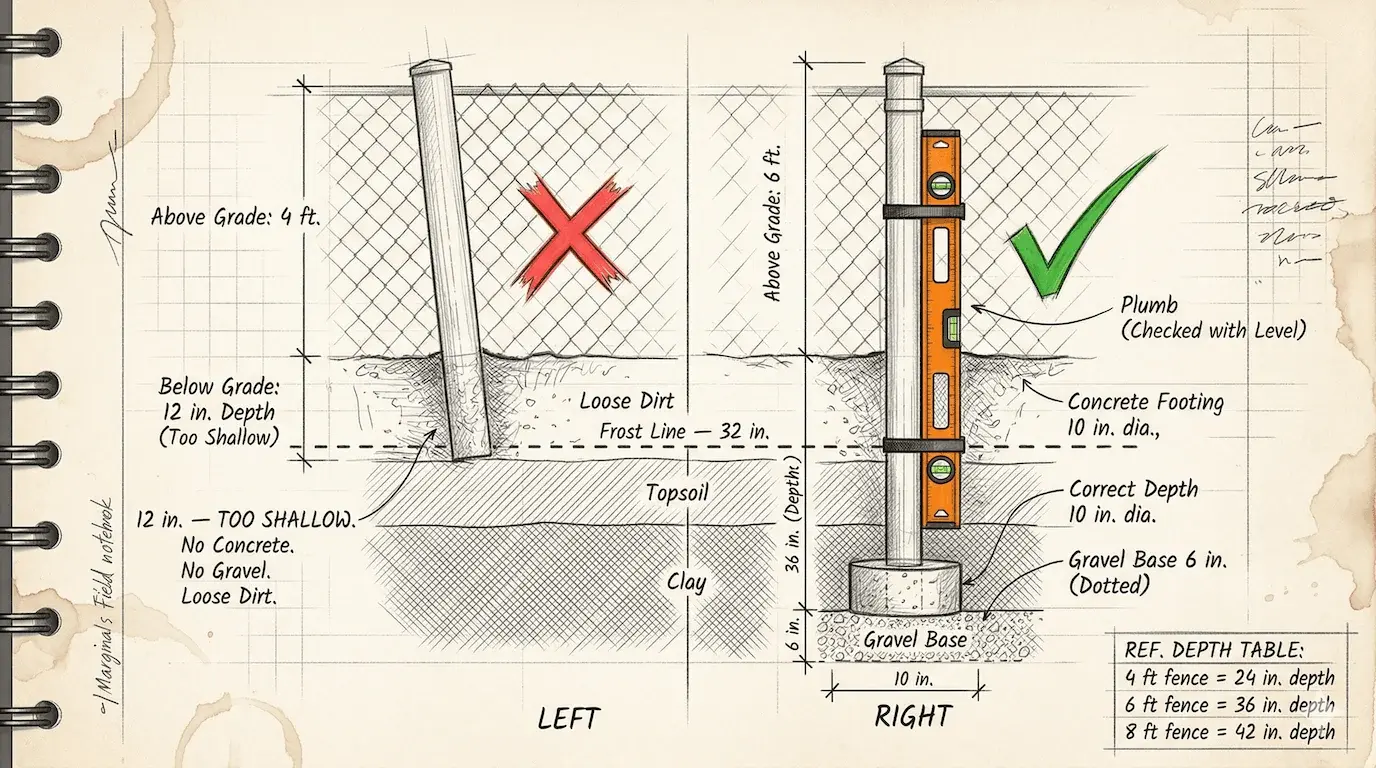
Fence Post Depth: The Complete Contractor's Guide by Fence Height
A 6-foot privacy fence with posts buried only 18 inches will lean within 14 months. We see it constantly, usually on callbacks that eat into margins. The fix is simple math and a post hole digger, but the number of contractors who eyeball depth instead of measuring is staggering. This guide gives you exact post depth specifications for every fence height from 3 feet to 12 feet, with adjustments for soil type, frost line, and footing method.
The 1/3 Rule: How Deep Should a Fence Post Be?
The baseline formula every contractor should know: bury 1/3 of the total post length underground, plus 6 inches for a gravel drainage base. A 6-foot fence needs an 8-foot post. One-third of 8 feet is 32 inches. Add 6 inches for gravel. That gives you a hole depth of 38 inches.
This rule applies across wood fence, vinyl fence, and chain link fence installations. The physics don't change based on material. Wind load does, and we'll cover that, but the depth foundation stays the same.
Why the extra 6 inches? Gravel at the bottom of every post hole serves two purposes. First, it allows water to drain away from the post base, which extends the life of wood posts by 5 to 8 years. Second, it provides a stable, level surface to set the post on before adding concrete or tamped earth.
Post Depth by Fence Height: Complete Reference Table
This table assumes standard soil conditions (loam or clay with moderate drainage) and a region with a frost line under 36 inches. If your frost line is deeper, see the regional adjustments below.
| Fence Height | Total Post Length | Underground Depth | Gravel Base | Total Hole Depth | Hole Diameter |
|---|---|---|---|---|---|
| 3 ft | 5 ft | 20 in | 6 in | 26 in | 8 in |
| 4 ft | 6 ft | 24 in | 6 in | 30 in | 8 in |
| 5 ft | 7 ft | 28 in | 6 in | 34 in | 10 in |
| 6 ft | 8 ft | 32 in | 6 in | 38 in | 10 in |
| 7 ft | 10 ft | 40 in | 6 in | 46 in | 10 in |
| 8 ft | 11 ft | 44 in | 6 in | 50 in | 12 in |
| 10 ft | 14 ft | 56 in | 6 in | 62 in | 12 in |
| 12 ft | 16 ft | 64 in | 6 in | 70 in | 14 in |
Notice the jump at 7 feet. Posts for fences 7 feet and taller typically require 10-foot or longer stock. At that height, you're also dealing with significantly more wind load, which is why the buried portion increases proportionally. A 12-foot security fence with posts buried less than 64 inches is a liability waiting to happen.
Why Fence Post Depth Matters More Than Post Material
Contractors debate wood versus steel versus vinyl posts constantly. Here's what the data actually shows: a properly set 4x4 pressure-treated pine post at 38 inches deep will outperform a steel post set at 24 inches deep. Every time. The International Residential Code (IRC) Section R105.2 references minimum embedment depths for a reason.
Wind is the primary force working against your fence. A standard 6-foot solid privacy fence panel catches approximately 20 pounds of force per square foot in a 60 mph wind. That's 720 pounds of lateral force on a single 8-foot-wide panel. All that force transfers to the posts. Shallow posts can't resist that lateral load.
Gate posts take even more abuse. A 6-foot gate swinging open and closed 4 to 6 times per day exerts repeated lateral stress on the hinge-side post. Gate posts should be set 4 to 6 inches deeper than line posts at minimum, and many contractors go 8 inches deeper as standard practice.
Frost Line Depth by Region
Your post hole must extend below the frost line, or frost heave will push your posts out of the ground over 2 to 3 winter cycles. If the 1/3 rule calculation gives you a depth that's shallower than your local frost line, the frost line wins. Always go deeper.
| Region | Typical Frost Line Depth | Key States | Minimum Post Depth (6 ft fence) |
|---|---|---|---|
| Deep North | 48 to 72 in | Minnesota, Wisconsin, Montana, North Dakota | 54 to 78 in |
| Northeast | 36 to 48 in | New York, Pennsylvania, Massachusetts, Connecticut | 42 to 54 in |
| Midwest | 30 to 42 in | Ohio, Indiana, Illinois, Iowa | 36 to 48 in |
| Mid-Atlantic | 24 to 36 in | Virginia, Maryland, Delaware, North Carolina | 30 to 42 in |
| South | 6 to 18 in | Texas, Florida, Georgia, Louisiana | 38 in (1/3 rule governs) |
| Pacific Northwest | 12 to 24 in | Washington, Oregon | 38 in (1/3 rule governs) |
| Mountain West | 36 to 60 in | Colorado, Utah, Wyoming, Idaho | 42 to 66 in |
| Southwest | 0 to 12 in | Arizona, New Mexico, Southern California | 38 in (1/3 rule governs) |
In Minnesota, a standard 6-foot fence post hole can be 78 inches deep. That's over 6 feet of digging for a 6-foot fence. It sounds excessive until you've pulled 14 heaved posts out of the ground in March and had to re-set them for free. Factor frost line depth into your bids in cold climates, or you'll lose money on warranty work.
Concrete Footings vs. Gravel Footings: When to Use Each
This is one of the most debated topics among fence contractors. Both methods work. The right choice depends on five factors: soil type, fence height, wind exposure, post material, and local code requirements.
Concrete Footings
Concrete is the default for most residential and commercial fence installations. A standard 6-foot fence post uses 1 to 2 bags (50 to 80 lbs each) of fast-setting concrete per hole. Total cost per post runs $4 to $8 in materials.
Use concrete when:
- Fence height exceeds 6 feet
- The fence is solid panel (wood or vinyl privacy) with high wind load
- Soil is sandy or loose with poor compaction
- Gate posts need maximum rigidity
- Local building code requires it (many jurisdictions mandate concrete for fences over 6 feet)
- Commercial or industrial chain link fence installations
The standard pour method: set the post, brace it plumb, pour dry fast-set concrete into the hole, add water per manufacturer directions (typically 1 gallon per 50-lb bag), and let it cure for 4 hours minimum before attaching rails. Full cure takes 24 to 48 hours.
Crown the concrete 1 to 2 inches above grade, sloping away from the post. This prevents water from pooling at the base, which is the number one cause of premature post rot in wood fences.
Gravel/Crushed Stone Footings
Gravel footings have gained popularity over the past decade, and for good reason. They drain better than concrete, they allow easy post replacement, and in well-draining soils they provide comparable lateral strength.
Use gravel when:
- Fence height is 6 feet or under
- The fence is open style (chain link, aluminum rail, split rail)
- Soil has good clay content and compacts well
- The customer may want to relocate or modify the fence later
- You're setting wood posts and want maximum drainage for longevity
The gravel method: dig the hole 4 inches wider than the post on each side. Pour 6 inches of 3/4-inch crushed stone at the bottom. Set the post. Backfill with crushed stone in 6-inch lifts, tamping each lift with a steel tamping bar for 15 to 20 seconds. The angular edges of crushed stone interlock when compacted, creating a rigid footing that rivals concrete in lateral resistance.
Do not use pea gravel. The rounded stones don't interlock and will shift under lateral load. Crushed stone with angular edges (often called "57 stone" or "crusher run") is the only acceptable aggregate for post footings.
Footing Comparison Table
| Factor | Concrete Footing | Gravel Footing |
|---|---|---|
| Material cost per post | $4 to $8 | $3 to $6 |
| Set time before loading | 4 to 48 hours | Immediate |
| Drainage | Poor (traps moisture against post) | Excellent (water drains through) |
| Post replacement ease | Difficult (must break out concrete) | Easy (dig out gravel, reset) |
| Lateral load resistance | High | Moderate to high (soil dependent) |
| Frost heave resistance | Moderate (can heave with post) | Good (gravel shifts, post stays) |
| Best for fence types | Privacy, tall, commercial | Open, residential, removable |
| Wood post lifespan impact | Reduces by 3 to 5 years | Extends by 3 to 5 years |
One underappreciated advantage of gravel footings: they resist frost heave better than concrete in many conditions. A concrete collar around a post gives frost something rigid to grip and push upward. Gravel allows the surrounding soil to shift while the post stays put. In areas with frost lines between 24 and 42 inches, this can be the deciding factor.
Soil Types and How They Affect Post Depth
Not all ground is created equal. The soil you're digging into changes everything about your post setting approach. Here's how to adjust.
Clay soil. Dense, heavy, holds moisture. Clay provides excellent lateral support once compacted. You can often get away with the minimum 1/3 rule depth in clay. The downside: clay retains water against the post, accelerating rot in wood. Use a generous gravel base (8 to 10 inches instead of 6) and consider gravel backfill for the bottom third of the hole to improve drainage.
Sandy soil. Loose, well-draining, poor lateral support. Sandy soil is the worst case for fence posts. Increase your buried depth by 20% over the 1/3 rule. A 6-foot fence in sand needs a hole depth of 44 to 46 inches instead of 38. Always use concrete in sand. Gravel footings won't hold.
Rocky soil. Hard to dig but excellent for post support once you get through it. If you hit solid rock at 28 inches on a 6-foot fence, you're usually fine. Drill into the rock with a hammer drill and 1/2-inch bit, set a J-bolt or expansion anchor, and attach a post bracket. Some contractors use hydraulic rock drills for this; rental runs about $250 per day.
Loam. The ideal. Good drainage, good compaction, easy to dig. Follow the standard 1/3 rule with no adjustments. Both concrete and gravel footings work well in loam.
Expansive soil. Found in parts of Texas, Colorado, and the Dakotas. This soil swells when wet and shrinks when dry, creating movement that can shift fence posts 2 to 4 inches seasonally. Use concrete footings with a bell shape at the bottom (wider at the base than the top) to resist uplift. Dig 6 inches deeper than the standard calculation.
Terminal Posts vs. Line Posts: Different Depth Requirements
Not every post in a fence line carries the same load. Terminal posts, which include end posts, corner posts, and gate posts, bear significantly more stress than line posts.
End posts resist the full pull of the fence fabric in one direction. For chain link fence, that tension can be 200 to 400 pounds depending on gauge and height. End posts should be set 4 to 6 inches deeper than line posts and use concrete regardless of what you're using for line posts.
Corner posts resist pull from two directions. They need the deepest setting of any post in the fence line, typically 6 to 8 inches deeper than line posts. Use a 12-inch diameter hole minimum for corner posts on fences 6 feet and taller.
Gate posts handle dynamic loads from the gate swinging, plus the dead weight of the gate hanging from hinges. A standard 4-foot-wide gate weighs 35 to 60 pounds. A double drive gate can weigh 120 to 180 pounds. Gate posts should be one size larger than line posts (use 4-inch when line posts are 2-7/8-inch) and set 6 to 8 inches deeper with concrete footings. No exceptions.
Line posts carry the fence fabric between terminal posts. They experience primarily lateral wind load. Standard 1/3 rule depth is sufficient for line posts in most conditions.
Common Post Depth Mistakes That Cost Contractors Money
These are the errors we see most often in the field.
Mistake 1: Uniform depth for all posts. Setting every post at 36 inches regardless of fence height or post function. Gate posts set at the same depth as line posts will fail within 2 years. Corner posts need more depth, not less.
Mistake 2: Ignoring the gravel base. Dropping the post directly onto dirt at the bottom of the hole. Without 6 inches of gravel underneath, water collects at the post base. Wood posts rot. Metal posts corrode. The fix costs $0.50 per hole in gravel. Skipping it costs you a full post replacement at $75 to $150 in 3 to 5 years.
Mistake 3: Digging too wide. A hole that's 18 inches in diameter for a 4x4 post uses 3 bags of concrete instead of 1.5. Over a 200-foot fence with 25 posts, that's an extra 37 bags of concrete at $5 each, or $185 in materials you didn't need to spend. Match hole diameter to the tables above.
Mistake 4: Not accounting for the post above grade. Fence height is measured from grade to top of fence. But many posts extend 1 to 2 inches above the top rail for cap fitment. Make sure your post length accounts for this. An 8-foot post for a 6-foot fence leaves 32 inches underground and 64 inches above grade, but if you need a 2-inch cap extension, you need an 8-foot-2-inch post or you'll lose 2 inches of buried depth.
Mistake 5: Setting posts before marking utilities. Call 811 at least 3 business days before digging. Hitting a gas line at 30 inches costs a lot more than a phone call. In most states, failing to call before digging makes the contractor liable for all repair costs, which can run $5,000 to $50,000 for a gas or fiber optic line.
Post Hole Equipment: Matching the Tool to the Job
The tool you use affects both speed and hole quality.
Manual post hole digger (clamshell). Works for 1 to 10 posts in soft soil. Digs a clean 6 to 8 inch diameter hole. Expect 5 to 15 minutes per hole in loam, 20 to 30 minutes in clay. Physical limit is about 36 inches deep before leverage becomes impractical.
One-person power auger. Gas-powered with 8 to 12 inch bits. Handles 10 to 40 posts per day. Rental cost: $60 to $100 per day. Works in most soils but will stall on heavy clay or roots over 2 inches in diameter.
Two-person power auger. More torque than the one-person version. Required for holes deeper than 42 inches or in heavy clay. Rental cost: $80 to $150 per day. Two operators reduce fatigue and improve control.
Skid steer auger attachment. The professional's choice for large jobs, 50 or more posts. Drills a 42-inch-deep hole in under 60 seconds in most soils. Rental cost: $250 to $400 per day for the skid steer plus $100 to $150 for the auger attachment. Pays for itself on any job over 30 posts in time savings alone.
Hydraulic post driver. For driving steel posts without digging. Common for T-posts and some round pipe posts. Drives a 7-foot T-post 24 inches into firm ground in about 10 seconds. Not suitable for wood posts or posts requiring concrete footings.
Special Situations
Slope installations. On grades steeper than 15%, you need to step the fence. Each step requires an end post on the high side and a line post on the low side, with the low-side post set deeper to compensate for grade erosion. Add 6 inches of depth for every 10% of grade.
Near retaining walls. When a fence runs along the top of a retaining wall, post depth gets complicated. The effective ground support starts at the base of the retaining wall, not at the grade where you're digging. If the retaining wall is 3 feet tall and you're setting a 6-foot fence, you may need posts buried 48 inches or more to reach stable, undisturbed soil. Consult a structural engineer for retaining walls over 4 feet tall.
High wind zones. Coastal areas, open plains, and hilltop properties experience sustained winds of 40 to 70 mph. For solid panel fences in these zones, increase post depth by 25% and use concrete footings exclusively. Consider reducing panel spacing from 8 feet to 6 feet to decrease wind load per post.
Near trees. Large tree roots can make digging impossible in some spots. If you can't achieve minimum depth due to roots, move the post location 12 to 18 inches rather than cutting major roots. Cutting roots over 2 inches in diameter can destabilize the tree, creating a much bigger liability than a slightly off-plan post location.
Post Depth for Different Fence Materials
While the 1/3 rule applies universally, certain materials have specific considerations.
Wood fence posts. Use pressure-treated posts rated for ground contact (UC4A or UC4B per AWPA standards). Standard 4x4 posts work for fences up to 6 feet. Switch to 4x6 or 6x6 for fences 7 feet and taller. Wood fence posts benefit from gravel footings for drainage, but concrete is acceptable if crowned properly above grade.
Steel pipe posts. Used for chain link and industrial applications. Standard Schedule 40 pipe in 2-3/8-inch (line posts) and 2-7/8-inch (terminal posts) diameters. Always set in concrete. Steel posts in gravel will lean over time because the smooth surface doesn't grip the aggregate the way wood's rough texture does.
Vinyl/PVC posts. Vinyl fence posts are hollow and rely on internal reinforcement (steel or aluminum inserts) for structural strength. The reinforcement insert must extend from 6 inches above grade down to the bottom of the concrete footing. Follow the same depth rules as wood, but always use concrete, never gravel alone.
Aluminum posts. Aluminum fence and rail posts are lighter than steel but structurally sufficient for ornamental and pool fences up to 6 feet. Set in concrete with a minimum 30-inch depth for 4-foot fences and 36-inch depth for 5 to 6-foot fences. Aluminum posts flanged at the base provide additional resistance to lateral loads.
Calculating Concrete Quantities
Running out of concrete mid-job is amateur hour. Running back to the supply house costs 45 minutes and kills momentum. Here's how to calculate accurately.
The formula for concrete volume per hole: Volume = pi x radius squared x depth of concrete (in feet). Convert to cubic feet, then divide by the yield per bag.
For a 10-inch diameter hole, 32 inches of concrete (38-inch hole minus 6-inch gravel base): Volume = 3.14 x (5/12)^2 x (32/12) = 1.45 cubic feet. A standard 50-lb bag of fast-set concrete yields 0.375 cubic feet. So you need 3.9 bags per hole. Round up to 4.
Quick reference: for a 6-foot fence with 10-inch diameter holes, budget 4 bags of 50-lb concrete per post. For a 200-foot fence line with posts every 8 feet (25 line posts plus 2 end posts), that's 108 bags. Add 10% waste factor: 119 bags. At $5 per bag, that's $595 in concrete for the job. Know this number before you bid.
Frequently Asked Questions
How deep should fence posts be for a 6-foot privacy fence?
A 6-foot privacy fence requires an 8-foot post with a minimum hole depth of 38 inches, which includes 32 inches of buried post plus a 6-inch gravel drainage base. In regions where the frost line exceeds 32 inches, dig to 6 inches below the frost line instead. Always use concrete footings for solid privacy panels due to high wind loads.
Can I use gravel instead of concrete for fence posts?
Yes, gravel footings work well for fences 6 feet and under in soil with good clay content. Use 3/4-inch angular crushed stone, not pea gravel, and compact in 6-inch lifts with a tamping bar. Gravel drains better than concrete and can extend wood post life by 3 to 5 years. However, always use concrete for gate posts, corner posts, and fences over 6 feet tall.
Do I need to dig below the frost line for fence posts?
If your local frost line depth exceeds the 1/3 rule calculation, yes. Your hole must reach at least 6 inches below the frost line to prevent frost heave from pushing posts out of the ground. In northern states like Minnesota and Wisconsin, this can mean digging 54 to 78 inches for a standard 6-foot fence. Check your local building code for exact frost line requirements.
How deep should gate posts be set?
Gate posts should be set 6 to 8 inches deeper than standard line posts and always in concrete. A gate post for a 6-foot fence needs a minimum 44 to 46 inch hole depth. Use posts one size larger than your line posts to handle the dynamic swinging load and dead weight of the gate, which can range from 35 pounds for a single walk gate up to 180 pounds for a double drive gate.
What happens if I don't dig fence posts deep enough?
Shallow posts lean within 12 to 18 months due to wind load and soil movement. Frost heave in cold climates will physically push shallow posts out of the ground over 2 to 3 winter cycles. Repair means digging out the old post, re-excavating to proper depth, and resetting, which costs $75 to $150 per post in labor and materials. On a 200-foot fence, that callback can eliminate your entire profit margin.