
Fence Permit Requirements: What Contractors Need to Know Before Breaking Ground
Last year, a contractor in Fairfax County, Virginia, installed 340 linear feet of 8-foot wood privacy fence without pulling a permit. The county ordered it removed. Total cost to the contractor: $14,200 in removal labor, $850 in disposal fees, and a $2,500 fine. The permit would have cost $75. Fence permit requirements vary by jurisdiction, but the consequences of ignoring them are universally expensive. This guide covers when permits are required, what they cost, how to navigate the process, and a state-by-state breakdown for the 10 most populated states.
When Do You Need a Fence Permit?
The short answer: it depends on your jurisdiction. There is no federal fence permit requirement. Permitting authority sits at the county or municipal level, and rules vary dramatically. However, patterns emerge across most of the country.
The most common triggers for fence permit requirements:
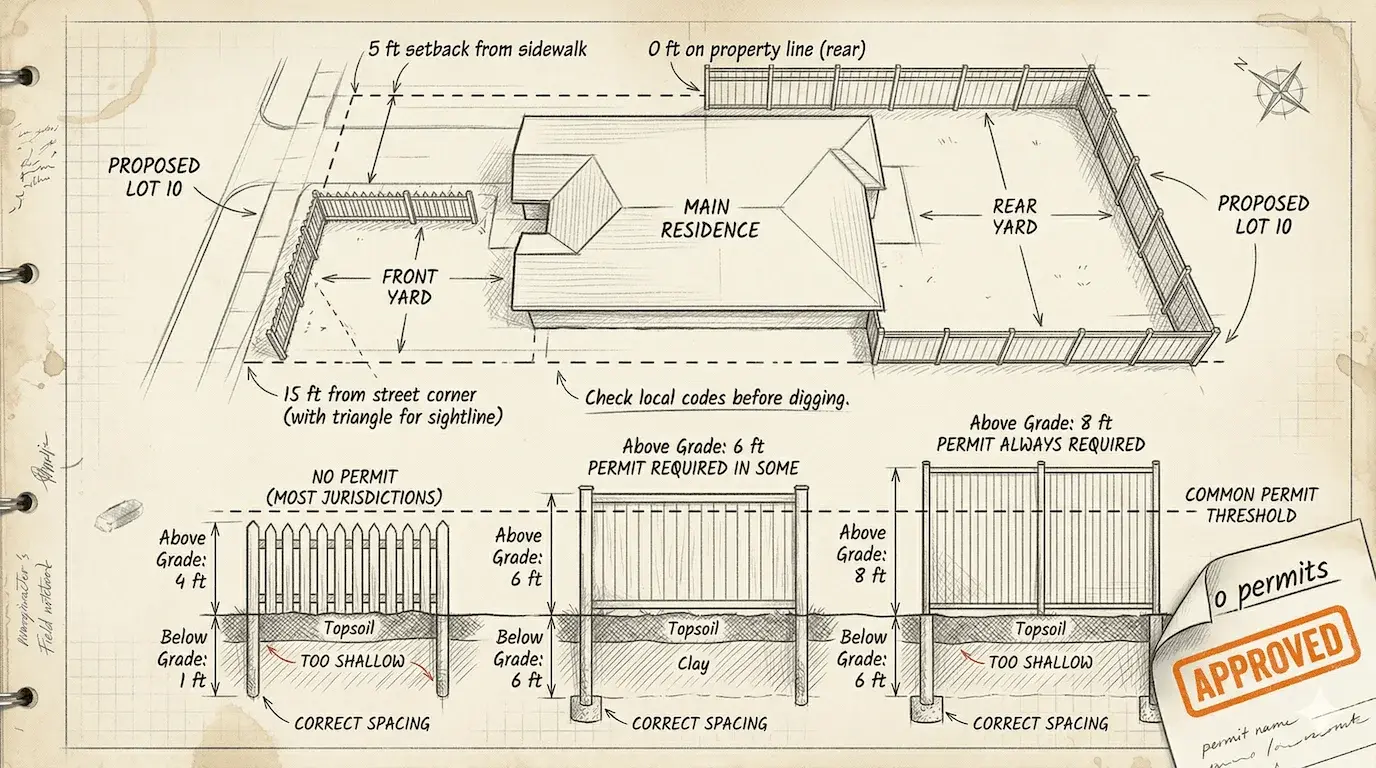
- Fence height exceeds 6 feet in the backyard
- Fence height exceeds 4 feet in the front yard
- Fence is located on a corner lot (sight triangle regulations)
- Fence is within a flood zone or wetland buffer
- Property is in a historic district
- Fence includes electrical components (electric gates, security systems)
- Pool fencing (almost always requires a permit and inspection)
- Commercial or industrial fencing
- Fence is on or near a property line (some jurisdictions require a survey)
Many jurisdictions exempt standard residential fences under 6 feet from permit requirements entirely. But "many" is not "all," and assuming your jurisdiction is one of them without checking is how contractors end up paying for removal and rebuild.
Permit Requirements by Fence Height
| Fence Height | Front Yard | Side Yard | Rear Yard | Permit Typically Required? | Notes |
|---|---|---|---|---|---|
| Under 3 ft | Usually allowed | Usually allowed | Usually allowed | Rarely | Decorative fences, garden borders |
| 3 ft to 4 ft | Usually allowed | Usually allowed | Usually allowed | Sometimes (front yard) | Common max for front yards in many cities |
| 4 ft to 6 ft | Often restricted or requires permit | Usually allowed | Usually allowed | Depends on jurisdiction | Most common residential fence height range |
| 6 ft | Restricted in most jurisdictions | Usually allowed | Usually allowed | Often no (rear/side); usually yes (front) | Standard max height without permit in many areas |
| 6 ft to 8 ft | Requires permit + variance | Requires permit | Requires permit | Yes, almost always | May require engineering or site plan |
| Over 8 ft | Requires permit + variance + hearing | Requires permit + variance | Requires permit + variance | Yes, always | Commercial/industrial; zoning board review likely |
Front yards are the strictest zone in virtually every jurisdiction. The reasoning is twofold: safety (maintaining sight lines for drivers at intersections) and aesthetics (community appearance standards). Most cities cap front yard fences at 3 to 4 feet, with some allowing up to 4.5 feet if the fence is at least 50% open (like aluminum rail or chain link).
The Permit Application Process
Pulling a fence permit is straightforward once you know the process. Most jurisdictions follow a similar workflow.
Step 1: Determine your jurisdiction. Fencing permits are issued by the city or county building department, not the state. If the property is within city limits, the city handles it. If it's in an unincorporated area, the county does. Some municipalities defer to the county for certain permit types. Call the local building department to confirm before submitting anything.
Step 2: Gather required documents. Most fence permit applications require:
- A site plan or plot plan showing the property boundaries, existing structures, and proposed fence location (hand-drawn is acceptable in most jurisdictions, but must be to scale)
- Fence specifications: height, material, style, total length
- Property survey (required in about 30% of jurisdictions; strongly recommended everywhere)
- HOA approval letter (if applicable)
- Contractor license number (required in roughly 60% of jurisdictions)
Step 3: Submit the application. Many jurisdictions accept online submissions. Others require in-person filing. Processing: 3 to 10 business days for residential, 10 to 30 for commercial. Some cities offer same-day permits for standard residential fences under 6 feet.
Step 4: Pay the fee. Residential fence permits range from $20 to $250. Commercial permits run $100 to $500. The median residential fee is $60 to $75.
Step 5: Post the permit. The permit must be posted visibly at the job site before construction begins, typically in a weather-protected holder on a stake near the street.
Step 6: Schedule inspection. About 40% of jurisdictions require a post-installation inspection. The inspector checks height, setback compliance, and material match to the approved plan. Inspections are typically free and scheduled within 3 to 5 business days.
Fence Permit Cost Table by Project Type
| Project Type | Typical Permit Fee | Processing Time | Inspection Required? | Additional Requirements |
|---|---|---|---|---|
| Residential fence under 6 ft | $20 - $75 | 1 - 5 business days | Sometimes | Site plan |
| Residential fence 6 - 8 ft | $50 - $150 | 5 - 10 business days | Usually | Site plan, may need variance |
| Pool fence (any height) | $50 - $200 | 5 - 10 business days | Always | Must meet barrier code, self-closing gate |
| Commercial fence under 8 ft | $100 - $300 | 10 - 20 business days | Usually | Site plan, engineering for wind load |
| Commercial fence over 8 ft | $200 - $500 | 15 - 30 business days | Always | Engineered drawings, zoning review |
| Fence with variance request | $150 - $500 (includes hearing fee) | 30 - 90 business days | Always | Public hearing, neighbor notification |
Setback Requirements
Setback is the minimum distance a fence must be from the property line, street, sidewalk, or other reference point. Setback rules exist to protect sight lines, utility access, and public right-of-way.
Property line setback. Most jurisdictions allow fences on or within 6 inches of the property line. However, "on" the property line means the fence must be entirely on your client's property. If any part of the fence crosses the property line, it's on the neighbor's land, which creates a trespassing issue and potential forced removal. This is why surveys matter. A $300 to $500 property survey costs far less than removing and rebuilding a 200-foot fence that's 8 inches over the line.
Street setback. Fences along streets typically must be set back 2 to 5 feet from the curb or edge of pavement. This allows for snow storage, utility access, and pedestrian safety. In some jurisdictions, the setback is measured from the right-of-way line (which is often 10 to 15 feet from the curb, not the property line).
Corner lot sight triangle. On corner lots, jurisdictions define a "sight triangle" at the intersection where fences must be limited to 30 to 36 inches in height. The triangle is typically measured 25 to 35 feet from the intersection along each street frontage. Anything taller blocks driver sight lines and creates an accident risk. This applies to all fence materials, including vinyl, wood, and solid privacy slats on chain link.
Utility easement. Many properties have utility easements along side or rear boundaries, typically 5 to 10 feet wide. Fences built within easements can be removed by the utility company at the property owner's expense, with zero compensation. Always check the property survey for easement locations before staking the fence line.
Sidewalk setback. Where sidewalks run along the property, fences must typically be set back 12 to 24 inches from the sidewalk edge. This allows for fence maintenance without encroaching on the public walkway and prevents fence overhang from narrowing the pedestrian path below the ADA minimum of 36 inches.
HOA Considerations
Homeowners associations add a second layer of approval on top of municipal permitting. In HOA communities, you need both HOA architectural approval and the municipal permit (if required). Neither one substitutes for the other.
HOA fence restrictions are typically more specific and more restrictive than municipal codes. Common HOA requirements include:
- Approved materials only (many HOAs prohibit chain link entirely)
- Specific color requirements (white, tan, natural cedar, or matching the home exterior)
- Maximum height lower than city code allows (commonly 4 feet in front, 5 feet in rear)
- Style requirements (horizontal boards only, vertical boards only, specific picket spacing)
- Finished side facing outward (the "good neighbor" rule)
- Pre-approved contractor lists (some HOAs restrict which companies can work in the community)
- Submission deadlines (many HOA architectural committees meet monthly, so missing the deadline delays the project by 30 days)
The HOA approval timeline is often the longest part of the permitting process. Plan for 2 to 6 weeks for architectural review committee approval. Some HOAs require neighbor notification or consent within a certain distance (commonly 25 to 100 feet) of the proposed fence.
As a contractor, you should build HOA approval lead time into your project timeline and communicate this to the customer upfront. A customer who calls you in March wanting a fence by April may be looking at June if their HOA meets monthly and requires neighbor notification.
How to Check Local Fence Codes
Checking fence codes before you bid saves time, prevents change orders, and demonstrates professionalism to your customers.
Online portals. About 70% of municipalities with populations over 25,000 publish their zoning ordinances online. Search for "[city name] fence ordinance" or "[city name] zoning code chapter [X]." Fence regulations are usually found in the zoning chapter under "accessory structures" or "fences and walls." Many cities also have a "fence FAQ" or "residential fence guide" PDF on their building department website.
Call the building department. For smaller municipalities or when online information is unclear, call the local building department directly. Have the property address ready. Ask specifically: "What are the fence height limits, setback requirements, and permit requirements for [property address]?" Most building department staff can answer these questions in under 5 minutes. Call during off-peak hours (Tuesday through Thursday, 10 AM to 2 PM) for the shortest hold times.
Visit in person. For complex projects, commercial fencing, or properties with unusual characteristics (corner lots, easements, historic districts, flood zones), visit the building department in person with a property survey and site plan. A 20-minute conversation with a plan reviewer can save you weeks of back-and-forth on a submitted application.
GIS and zoning maps. Most counties maintain a GIS (Geographic Information System) portal that shows property boundaries, zoning designations, easements, and flood zones. Search for "[county name] GIS" or "[county name] property search." Cross-reference the property's zoning designation with the zoning ordinance's fence requirements. A property zoned R-1 (single-family residential) may have different fence rules than one zoned R-3 (multi-family) or C-1 (commercial).
Penalties for Building Without a Permit
The consequences of unpermitted fence construction range from a minor fine to forced removal. Here's what you're risking.
Fines. First-offense fines for unpermitted fence construction range from $100 to $1,000 in most jurisdictions. Repeat offenses can escalate to $5,000 or more. Some cities impose daily fines ($50 to $200 per day) until the fence is either permitted retroactively or removed. A fence that sits unpermitted for 30 days at $100/day is a $3,000 fine before you even address the fence itself.
Stop work orders. If a code enforcement officer spots unpermitted construction in progress, they'll issue a stop work order. You cannot continue until the permit is obtained. This delays the project by days or weeks and can trigger penalty fees on top of the standard permit cost.
Forced removal. If the fence violates setback, height, or material requirements and cannot be brought into compliance, the jurisdiction can order removal at the property owner's expense. If the owner doesn't comply, the jurisdiction can remove it and bill the owner, often at 2 to 3 times what a private contractor would charge.
Retroactive permits. Many jurisdictions allow you to apply for a permit after the fact, but charge a penalty, typically double the standard permit fee. A $75 permit becomes $150. Some jurisdictions also require partial disassembly for inspection (uncovering footings to verify depth, for example), which adds labor cost.
Impact on property sale. Unpermitted structures show up during title searches and home inspections. An unpermitted fence can delay or derail a home sale. Buyers' attorneys routinely request removal or retroactive permitting as a condition of closing. This comes back on the homeowner, who then comes back on you.
Insurance and liability. If an unpermitted fence causes injury (a child climbs an unpermitted pool fence that doesn't meet barrier code, for example), the lack of permit can be used as evidence of negligence. Your liability insurance may not cover claims related to unpermitted work. Check your policy.
Pool Fence Requirements: A Special Case
Pool fencing is regulated more strictly than any other fence type because it's a life safety issue. Drowning is the leading cause of unintentional death for children ages 1 to 4. Every state has pool barrier requirements, and most align with the International Swimming Pool and Spa Code (ISPSC) or the International Residential Code (IRC) Section R326.
Key requirements that apply in most jurisdictions:
- Minimum height: 48 inches (4 feet) from the outside grade
- Maximum gap between bottom of fence and ground: 2 inches on hard surfaces, 4 inches on grass/soil
- Openings in fence fabric: must not allow passage of a 4-inch sphere (this eliminates chain link with mesh larger than 1-3/4 inches for pool barriers)
- No climbable elements (horizontal rails, decorative scrollwork) on the outside of the fence within 45 inches of grade
- Self-closing, self-latching gates with latch at least 54 inches above grade (out of children's reach)
- Gate must open outward, away from the pool
- No lock mechanisms that can be operated by a child (push-button locks are not acceptable)
Pool fence inspections are mandatory in every jurisdiction that has adopted the IRC or ISPSC. Inspectors bring a 4-inch sphere to test every opening, check gate closing speed (must close and latch within 15 seconds without assistance), and measure every dimension. Failures require re-inspection at $50 to $100.
State-by-State Overview: Top 10 States by Population
This table covers the general fence permit landscape in the 10 most populated states. Rules vary by municipality within each state, so always verify with the local building department. These are common patterns, not guarantees.
| State | Population | Permit for Fences Under 6 ft? | Max Height Without Variance | Front Yard Max | Typical Permit Fee | Key Notes |
|---|---|---|---|---|---|---|
| California | 39.0M | Usually no (most cities) | 6 ft rear/side, 3.5 ft front | 3-4 ft | $50 - $200 | Coastal Commission adds review in coastal zones; pool fences strictly enforced; fire-resistant materials may be required in WUI zones |
| Texas | 30.5M | Varies widely (no in many rural counties) | 8 ft (many cities); 6 ft common in HOAs | 4 ft typical | $25 - $100 | Fewer restrictions in unincorporated areas; HOA rules dominate in suburbs; no state building code (local only) |
| Florida | 22.6M | Yes in most cities | 6 ft (8 ft with permit) | 4 ft | $50 - $150 | Pool barrier code heavily enforced; hurricane wind load requirements in coastal counties; many HOAs restrict chain link |
| New York | 19.6M | Yes (NYC and most municipalities) | 6 ft | 4 ft | $100 - $300 | NYC requires DOB permit for all fences; Long Island towns vary; setback rules strict in suburban areas |
| Pennsylvania | 12.9M | Varies (no in many townships) | 6 ft | 3-4 ft | $25 - $100 | UCC (Uniform Construction Code) applies statewide; some townships exempt fences entirely; Philadelphia requires permits |
| Illinois | 12.5M | Yes (Chicago and most suburbs) | 6 ft (5 ft in some suburbs) | 3.5-4 ft | $50 - $150 | Chicago requires permit for all fences; many suburbs restrict front-yard fences entirely; corner lot sight triangle rules common |
| Ohio | 11.8M | Varies (many cities require it) | 6 ft | 4 ft | $25 - $75 | Residential Building Code applies; Columbus, Cleveland, Cincinnati all require permits; frost line 32-42 inches |
| Georgia | 11.0M | Varies (yes in Atlanta, no in many counties) | 8 ft (varies) | 4 ft | $25 - $100 | Metro Atlanta cities vary significantly; unincorporated Fulton County more relaxed; pool barriers required statewide |
| North Carolina | 10.7M | Varies (no in many areas for under 6 ft) | 6-8 ft | 3-4 ft | $25 - $75 | State building code applies; Charlotte and Raleigh require permits; HOA restrictions very common in new developments |
| Michigan | 10.0M | Varies (yes in most cities) | 6 ft | 3-4 ft | $25 - $100 | Frost line 42-48 inches affects post depth; Detroit requires permits; many suburban townships have specific fence ordinances |
A few patterns stand out. States without a statewide building code (Texas being the most notable) delegate everything to local jurisdictions, which creates wide variation even within a single metro area. States with uniform construction codes (Pennsylvania, New Jersey, Virginia) have more consistent rules, but local zoning still controls height, setback, and material restrictions.
Common Fence Types and Their Permit Implications
Different fence materials can trigger different code requirements. Here's what to watch for.
Wood privacy fence. The most common type installed in residential settings. Wood fences at 6 feet or under typically fall within standard permit exemptions (where exemptions exist). Solid board construction is treated differently than spaced picket in some jurisdictions, particularly in front yards. A 4-foot fence with 50% or more open space may be allowed in front yards where a 4-foot solid fence is not.
Chain link fence. Chain link is generally treated the same as other fence types for height and setback purposes. However, some HOAs and historic districts prohibit it entirely. Adding privacy slats to chain link converts it from an "open" fence to a "solid" fence in the eyes of most codes, which may change the height restriction. A 6-foot chain link fence allowed in a front yard because it's open may become non-compliant when slats are added.
Vinyl fence. Vinyl fencing follows the same permit rules as wood in most jurisdictions. Some older codes specifically reference "wood fence" in their regulations. When the code doesn't mention vinyl, check whether the local building department interprets vinyl as equivalent to wood or classifies it differently. In practice, most do treat them the same.
Aluminum/ornamental fence. Aluminum rail fencing is classified as an "open" fence style, which often allows it in locations where solid fencing is restricted. Many jurisdictions allow 4-foot ornamental aluminum fencing in front yards without a permit, while prohibiting 4-foot solid wood fencing in the same location.
Retaining wall with fence. When a fence sits on top of a retaining wall, most jurisdictions measure the total height from the lower grade to the top of the fence. A 3-foot retaining wall topped with a 4-foot fence creates a 7-foot barrier, which exceeds the 6-foot threshold and requires a permit. This catches contractors off guard more often than any other height-measurement issue.
Commercial and Industrial Fence Permits
Commercial fencing almost always requires a permit, regardless of height. The permit process for commercial work is more involved than residential.
Commercial fence permits typically require:
- A site plan prepared by a licensed surveyor or engineer, showing the fence relative to property lines, easements, parking areas, and existing structures
- Engineering calculations for wind load resistance (especially for solid panel fences and fences over 8 feet)
- Compliance with ADA requirements for gates (minimum 36-inch clear opening, no more than 5 pounds of force to open)
- Fire department approval for gates across fire access lanes (must be minimum 20 feet wide and either unlocked or equipped with emergency access devices)
- Stormwater review if the fence will divert water flow patterns (solid fences along grade can act as dams during heavy rain)
Commercial permit fees run $100 to $500, but the real cost is time. Expect 2 to 4 weeks for review, and 4 to 8 weeks if a variance hearing is needed. Build this timeline into your project schedule.
Permit Checklist for Contractors
Use this checklist before every fence installation to avoid permit-related problems.
- Identify the property's jurisdiction (city or unincorporated county)
- Check the zoning designation (residential, commercial, historic, flood zone)
- Verify fence height limits for the specific yard location (front, side, rear)
- Determine if a permit is required for the planned fence type and height
- Check setback requirements from property lines, streets, and sidewalks
- Verify no easements cross the fence line (check survey or GIS)
- Confirm HOA approval if applicable
- Call 811 for utility marking (minimum 3 business days before digging)
- Obtain the permit and post it on site before starting work
- Schedule inspection after completion if required
- Keep a copy of the approved permit and inspection report in your project file
Print this list. Put it in every bid folder. The 5 minutes it takes to run through these items on a $3,000 residential fence job can save you $10,000+ in fines, removal costs, and lost reputation.
Variance Requests: When the Code Says No
Sometimes the customer needs a fence that doesn't comply with local code. A business needs an 8-foot security fence in a zone that caps height at 6 feet. A homeowner on a busy corner wants a 6-foot privacy fence in their front yard. These situations require a variance.
A variance is a formal exception to the zoning code, granted by the local Board of Zoning Appeals (BZA) or equivalent body. The process typically involves:
- Application fee: $150 to $500
- Written justification: the applicant must demonstrate a "hardship" that makes compliance impractical (noise, safety, unusual lot shape)
- Notification: adjacent property owners must be notified by mail, typically 15 to 30 days before the hearing
- Public hearing: the BZA reviews the request, hears from the applicant and any objecting neighbors, and votes
- Timeline: 30 to 90 days from application to hearing, depending on the BZA meeting schedule
Variance approval rates vary. Requests with legitimate hardship and no neighbor opposition are approved roughly 70% to 80% of the time. Requests based purely on aesthetic preference are approved about 30% to 40% of the time. Help customers by documenting the need: break-in history for security fences, decibel readings for noise barriers, photos for privacy issues.
Frequently Asked Questions
Do I need a permit for a 6-foot fence in my backyard?
In about 60% of U.S. municipalities, a standard 6-foot fence in a rear or side yard does not require a permit. However, the remaining 40% do require one, including most large cities and suburban jurisdictions. The only way to know for certain is to check with your local building department. The permit fee is typically $25 to $75, making it far cheaper than the $100 to $1,000 fine for building without one.
What happens if I build a fence without a permit?
Consequences range from a retroactive permit at double the normal fee ($50 to $300) to forced removal and fines up to $5,000. Code enforcement is complaint-driven in most areas, meaning an unpermitted fence may go unnoticed for years until a neighbor dispute triggers a report. Even then, the fence may need to be modified or removed to comply. Unpermitted structures also create problems during home sales, as buyers' inspectors flag them routinely.
How long does it take to get a fence permit?
Standard residential fence permits take 1 to 10 business days in most jurisdictions. Some cities offer same-day or over-the-counter permits for standard residential fences under 6 feet. Commercial permits take 10 to 30 business days. Variance requests add 30 to 90 days for the public hearing process. Build permit lead time into your project schedule and communicate expected timelines to customers during the bidding process.
Are there different permit rules for front yard fences versus backyard fences?
Yes. Front yard fences face the strictest regulations in virtually every jurisdiction. Most cities limit front yard fence height to 3 to 4 feet and may require that the fence be at least 50% open (not solid). Rear and side yard fences are typically allowed up to 6 feet with fewer restrictions. Corner lots face additional rules for sight triangles at intersections, where fence height may be limited to 30 to 36 inches within 25 to 35 feet of the corner.
Do HOA fence rules override city codes?
HOA rules and city codes operate independently. You must comply with both. HOA restrictions are often more restrictive than city codes, limiting approved materials, colors, heights, and styles. The HOA can prohibit a fence type that the city allows, but the HOA cannot authorize a fence that violates city code. Always obtain both HOA architectural approval and the municipal permit (if required) before starting construction.