
How to Choose a Commercial Fence: A Contractor's Decision Framework
Last year, a contractor installed 1,200 linear feet of 4-foot ornamental aluminum around a public park in central Florida. Three months later, the county called him back. They needed 8-foot anti-climb mesh around the adjacent water treatment plant, and the aluminum would not cut it. Two jobs, same property, completely different fence requirements. That is the reality of commercial fencing. The right fence for one application is the wrong fence for another, and the consequences of a bad recommendation are measured in liability, not just aesthetics.
Commercial fence selection comes down to five variables: security level, budget, expected lifespan, maintenance burden, and regulatory compliance. This guide gives you a systematic way to evaluate those variables for every commercial bid you take, from a strip mall parking lot to a federal facility perimeter.
Commercial Fence Types Compared
Before diving into application-specific recommendations, here is a head-to-head comparison of the six fence types most commonly specified for commercial projects. Use this table as a starting point when evaluating bids.
| Fence Type | Security Level | Installed Cost/LF | Lifespan | Maintenance | ADA Compliant | Aesthetic Rating |
|---|---|---|---|---|---|---|
| Chain Link (galvanized) | Low-Medium | $12-$25 | 15-20 years | Low | Yes (with proper gate hardware) | 2/10 |
| Chain Link (vinyl-coated) | Low-Medium | $15-$32 | 20-25 years | Low | Yes | 4/10 |
| Ornamental Aluminum | Low-Medium | $26-$45 | 30-50 years | Very Low | Yes | 8/10 |
| Steel Palisade | High | $40-$70 | 25-40 years | Medium (rust prevention) | Yes (with compliant gates) | 3/10 |
| Anti-Climb Mesh (358 mesh) | Very High | $45-$80 | 20-30 years | Low | Yes | 3/10 |
| PVC Privacy | Low (visual barrier) | $22-$40 | 20-30 years | Very Low | Yes | 6/10 |
A few notes on this table. Installed cost per linear foot includes materials and labor but not site preparation, grading, or permits. Lifespan assumes proper installation and normal environmental exposure. Coastal, industrial, or high-pollution environments will shorten all lifespans by 20% to 40% unless premium coatings are specified.
Decision Framework: Five Questions for Every Commercial Bid
Walk through these five questions with the property owner or facility manager before recommending a fence type. Skip one, and you risk specifying the wrong product.
1. What is the primary purpose?
Commercial fences serve one or more of these functions:
- Perimeter security: Preventing unauthorized entry. Requires height (8 feet minimum), anti-climb features, and durable construction.
- Access control: Directing foot and vehicle traffic through designated entry points. Requires gates with hardware for keypads, card readers, or intercom systems.
- Property delineation: Marking boundaries without high security. A 4-foot ornamental aluminum fence at a professional office park, for example.
- Visual screening: Blocking sight lines for privacy or aesthetics. Dumpster enclosures, mechanical equipment areas, outdoor storage. PVC privacy fence or chain link with privacy slats are common solutions.
- Safety enclosure: Pool fencing, playground perimeters, rooftop barriers. These have specific code requirements that override all other considerations.
Most commercial properties need more than one function, which often means more than one fence type on the same project.
2. What are the regulatory requirements?
Commercial fence installations are governed by local zoning codes, building codes, HOA or business park covenants, and industry-specific regulations. Common requirements include:
- Maximum height: Many municipalities cap front-yard commercial fencing at 4 feet and side/rear at 6 or 8 feet. Variances are available but add 2 to 6 weeks to the project timeline.
- Setback: Fences may need to be set back 6 inches to 2 feet from the property line, depending on jurisdiction.
- Sight triangle: At intersections and driveways, fences within the sight triangle (typically 25 feet from the corner) may not exceed 30 to 36 inches in height.
- Pool enclosures: Minimum 48-inch height (60 inches in some states), self-closing and self-latching gates, no climbable horizontal rails, latch at 54 inches on pool side.
- ADA compliance: Gate openings must be at least 32 inches clear width (36 inches preferred), hardware operable with one hand and no tight grasping, threshold maximum 1/2 inch.
3. What is the total cost of ownership?
The installed price is not the full cost. A $15-per-foot chain link fence that needs recoating every 5 years and replacement at year 15 costs more over 30 years than a $35-per-foot aluminum fence that lasts 40 years with zero maintenance. Run the numbers for your client.
| Fence Type | Install Cost (per LF) | Annual Maintenance (per LF) | Replacement Cycle | 30-Year Total Cost (per LF) |
|---|---|---|---|---|
| Galvanized Chain Link | $18 | $0.50 | 18 years | $51 (1 replacement + maintenance) |
| Vinyl-Coated Chain Link | $24 | $0.25 | 22 years | $55.50 (1 replacement + maintenance) |
| Ornamental Aluminum | $35 | $0.10 | 40+ years | $38 (no replacement) |
| Steel Palisade | $55 | $1.00 | 30 years | $85 (maintenance heavy) |
| Anti-Climb Mesh | $60 | $0.30 | 25 years | $78 (1 replacement + maintenance) |
| PVC Privacy | $32 | $0.15 | 25 years | $68.50 (1 replacement + maintenance) |
This table makes the case for aluminum in applications where security is not the primary driver. Present these numbers to property managers and facility directors. They think in total cost of ownership, not just installation price.
4. What environmental factors apply?
The installation environment directly impacts material selection:
- Coastal (salt air): Aluminum and PVC excel. Steel corrodes rapidly without marine-grade coatings. Galvanized chain link lasts 8 to 12 years instead of 15 to 20 near salt water.
- Industrial (chemical exposure): PVC and vinyl-coated chain link resist chemical degradation. Bare steel and aluminum can pit from acidic or alkaline exposure.
- High wind: Open designs (chain link, aluminum picket) allow wind to pass through. Solid designs (PVC privacy, solid panels) act as sails. A 6-foot solid fence in a 70 mph wind takes approximately 20 pounds of force per square foot, roughly 960 pounds on a single 8-foot section.
- Snow and ice: Vinyl becomes brittle below 40 degrees Fahrenheit. Chain link and aluminum handle freeze-thaw cycles without structural concern. Steel palisade can trap ice between pale tops, adding weight load.
- Soil conditions: Rocky soil increases installation costs by $3 to $8 per linear foot due to slower drilling and potential need for rock anchors. Sandy soil may require wider post holes (14-inch diameter instead of 10-inch) for adequate concrete grip.
5. What access control is needed?
Gates are the most expensive and most complex component of any commercial fence system. Specify them carefully.
- Pedestrian gates: 36 to 48 inches wide, ADA-compliant hardware. Budget $400 to $1,200 per gate including hardware.
- Single swing vehicle gates: 12 to 16 feet wide. Require a gate operator ($2,500 to $6,000) for automated access. Manual swing gates this wide need heavy-duty hinges rated for the gate weight.
- Double swing vehicle gates: 20 to 24 feet wide. Each leaf is 10 to 12 feet. Dual operators recommended for automated systems.
- Cantilever slide gates: 20 to 40 feet wide. Best for high-traffic commercial entrances. No ground track to maintain, no overhead clearance issues. Gate operators for cantilever gates cost $3,500 to $8,000.
- Barrier arm gates: For parking lots and low-security vehicle control. Not a fence gate per se, but often integrated into the fence line. Budget $2,000 to $5,000 per arm.
For any automated gate, confirm that the fence posts flanking the gate opening can support the operator's mounting hardware. Most operators require a steel post or reinforced concrete pillar, not a standard fence post.
Application-Specific Recommendations
Here is what works and what does not work for the most common commercial applications you will encounter.
Warehouses and Distribution Centers
Security is the primary concern. These facilities store high-value inventory and operate 24/7 with frequent truck traffic.
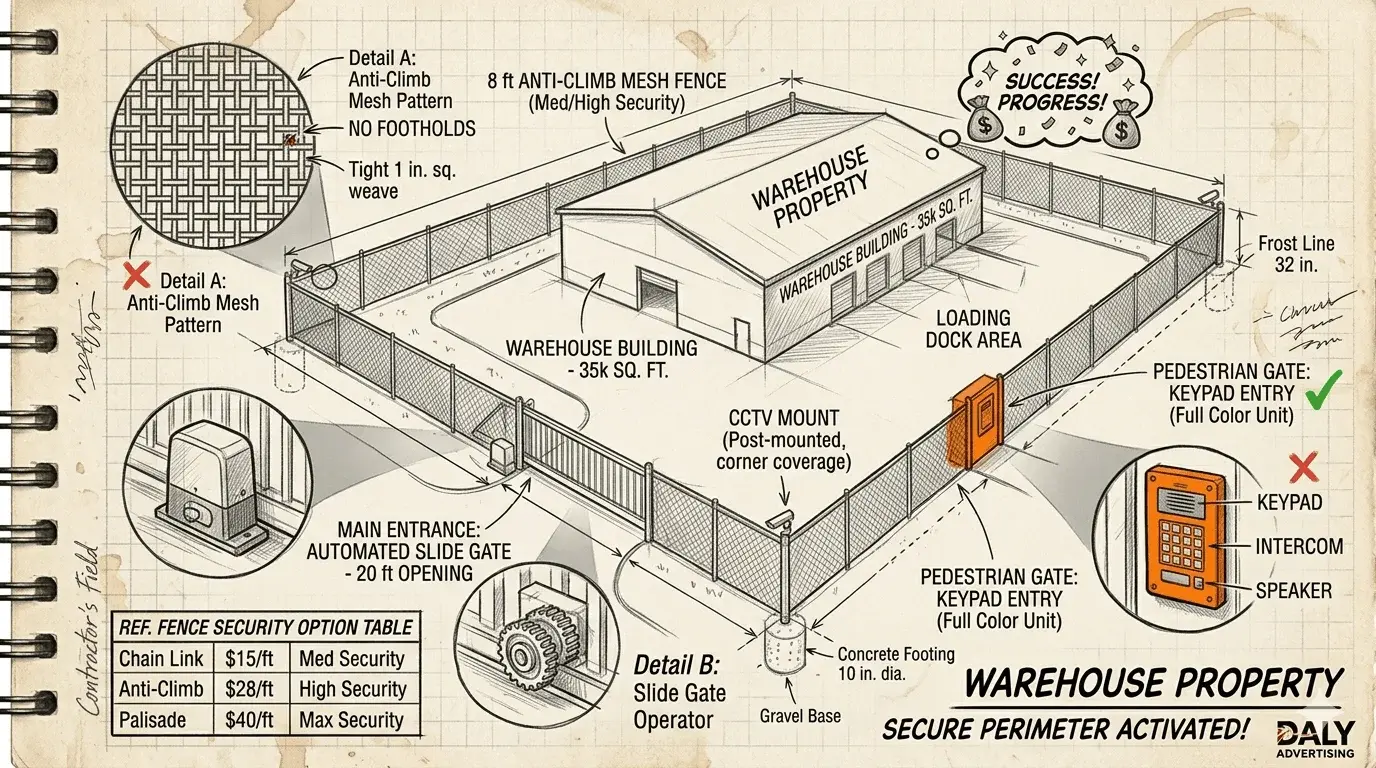
- Recommended: 8-foot galvanized or vinyl-coated chain link with 3-strand barbed wire top (adds 12 inches of height). 9-gauge fabric minimum, 2-inch mesh.
- Gate: Cantilever slide gate, 24 feet minimum, with operator and keypad access. Secondary pedestrian gate with card reader.
- Upgrade option: Anti-climb mesh (358 mesh) for high-value or high-risk facilities. The tight 3" x 0.5" mesh openings prevent finger and toe holds.
- Budget: $18 to $28 per linear foot for chain link, $55 to $75 per linear foot for anti-climb mesh. A 2,000-foot perimeter runs $36,000 to $56,000 for chain link or $110,000 to $150,000 for anti-climb.
Schools (K-12)
Schools need a balance of security, visibility, and aesthetics. The fence must keep unauthorized people out and students in, while allowing staff to see what is happening on the perimeter.
- Recommended: 6-foot vinyl-coated chain link (black or green) for athletic fields and rear perimeters. Ornamental aluminum (54 to 60 inches) for front-facing areas visible from the street.
- Gate: Multiple pedestrian gates (bus loading, parent pickup, athletic fields) with panic hardware for emergency egress. Vehicle gates at service entrances.
- Key consideration: No climbable horizontal rails on front perimeter fence. Ornamental aluminum with vertical pickets on 4-inch centers is preferred. Anti-climb features at sensitive areas near main building entrances.
- Budget: $20 to $30 per linear foot for vinyl-coated chain link, $30 to $45 per linear foot for ornamental aluminum. A typical K-8 school campus with 3,000 feet of perimeter runs $60,000 to $135,000 in mixed fencing.
Public Parks and Recreation Areas
Parks prioritize aesthetics and boundary marking over security. The fence defines the space and keeps vehicles out but is not designed to stop determined intruders.
- Recommended: 42 to 48-inch ornamental aluminum, 2-rail or 3-rail. Black powder-coated is the standard specification for parks departments.
- Gate: Self-closing pedestrian gates at trail entrances and ADA-accessible paths. Double swing gates (8 to 12 feet) for maintenance vehicle access.
- Key consideration: Picket spacing must not exceed 4 inches (entrapment code). Many parks departments specify 3.5-inch spacing.
- Budget: $26 to $40 per linear foot. A 1,500-foot park perimeter runs $39,000 to $60,000.
Parking Lots
Parking lots need perimeter definition, vehicle and pedestrian control, and sometimes security for overnight storage.
- Recommended: 4 to 6-foot chain link (galvanized or vinyl-coated) for basic perimeter. Add privacy slats if the lot is adjacent to residential areas. Ornamental aluminum for customer-facing commercial parking (office buildings, medical facilities).
- Gate: Barrier arms for access control, slide or swing gates for after-hours locking.
- Key consideration: Height restriction in front setback areas. Many zoning codes limit front-facing fence to 42 inches in commercial zones. Check before bidding.
- Budget: $12 to $22 per linear foot for basic chain link, $18 to $30 per linear foot with privacy slats.
Construction Sites (Temporary)
Temporary fencing has different priorities. It must go up fast, come down fast, secure the site during active construction, and meet OSHA requirements.
- Recommended: 6-foot temporary chain link panels on portable bases (concrete blocks or weighted stands). Standard panel size is 6 feet high by 12 feet wide. Add HDPE shade cloth for dust control and visual screening on sites adjacent to occupied properties.
- Gate: Drive-through opening with overlapping panels secured by clamps. No permanent gate installation.
- Key consideration: Wind load on shade cloth panels. Use 70% shade cloth rather than solid tarps. The 70% rating blocks most dust and debris while allowing enough airflow to prevent panels from blowing over in moderate wind (30 to 40 mph).
- Budget: Rental runs $3 to $7 per panel per week. Purchase runs $85 to $150 per panel. A 500-foot perimeter needs approximately 42 panels.
Government and Military Facilities
These installations have the highest security requirements and are often governed by specific federal standards (DoD UFC 4-022-01 for military, GSA PBS-P100 for federal buildings).
- Recommended: 8 to 10-foot anti-climb mesh (358 mesh) or reinforced chain link (6-gauge fabric, 1-inch mesh). Topped with razor wire or concertina wire (Y-arm extension). Crash-rated bollards or barriers at vehicle entry points.
- Gate: Crash-rated slide gates (K-rated per ASTM F2656). These gates cost $15,000 to $40,000 each. Hydraulic operators with battery backup.
- Key consideration: Clear zones of 20 feet on both sides of the fence (no vegetation, structures, or stored materials). Intrusion detection integration (vibration sensors, fiber optic cable in the fabric). CCTV mounting provisions on posts.
- Budget: $75 to $150 per linear foot, excluding electronic security integration. A 5,000-foot high-security perimeter runs $375,000 to $750,000 for fence alone.
Recommended Fence Type by Commercial Application
Use this quick-reference table when you are on a site visit and need to make a fast recommendation. It covers the 12 most common commercial scenarios.
| Application | Primary Fence Type | Height | Key Feature | Typical Cost/LF |
|---|---|---|---|---|
| Warehouse / Distribution | Chain Link + Barbed Wire | 8 ft + 1 ft | 9-gauge, 2" mesh | $18-$28 |
| Retail / Shopping Center | Ornamental Aluminum | 4-5 ft | Decorative, ADA gates | $28-$42 |
| School Campus | Vinyl-Coated Chain Link / Aluminum | 6 ft / 4.5 ft | Visibility, anti-climb | $20-$45 |
| Public Park | Ornamental Aluminum | 42-48 in | 3.5" picket spacing | $26-$40 |
| Parking Lot | Chain Link / Aluminum | 4-6 ft | Access control gates | $12-$30 |
| Construction Site | Temporary Chain Link Panels | 6 ft | Portable, shade cloth | $3-$7/wk rental |
| Government / Military | Anti-Climb Mesh + Razor Wire | 8-10 ft | Crash-rated gates | $75-$150 |
| Medical / Hospital | Ornamental Aluminum | 5-6 ft | ADA compliance, aesthetics | $30-$45 |
| Church / Place of Worship | Ornamental Aluminum / Vinyl | 4-5 ft | Decorative, welcoming | $26-$40 |
| Dumpster / Equipment Enclosure | PVC Privacy | 6-8 ft | Visual screening | $28-$42 |
| Dog Kennel / Animal Facility | Chain Link (vinyl-coated) | 6 ft | Chew-proof, easy clean | $18-$30 |
| Solar Farm / Utility | Chain Link + Wildlife Gates | 7 ft | Bottom clearance for small animals | $16-$26 |
Height Requirements by Application
Height is one of the first specifications you lock in because it determines post length, hole depth, and material cost. Here is a summary of standard and code-driven height requirements.
- Property line delineation: 36 to 48 inches. Low enough to see over, tall enough to discourage casual crossing.
- Pedestrian deterrent: 48 to 60 inches. Discourages most people from climbing over. Standard for parks, retail frontages, and medical campuses.
- Standard security: 72 inches (6 feet). The baseline for most commercial perimeter fencing. Meets code in virtually all jurisdictions for side and rear property lines.
- Enhanced security: 96 inches (8 feet). Required for warehouses, data centers, and any facility with high-value inventory. Often topped with 3-strand barbed wire adding 12 inches, for a total of 108 inches (9 feet).
- High security: 96 to 120 inches (8 to 10 feet). Government, military, corrections. Topped with razor wire or concertina coils adding 18 to 24 inches.
- Pool enclosure: 48 inches minimum (many states require 54 to 60 inches). Must have no horizontal rails or climbable features below 45 inches.
Anti-Climb and Anti-Cut Features
For security-grade commercial fencing, the fence itself is only the first layer. Anti-climb and anti-cut features add meaningful deterrent value.
Anti-climb options:
- 358 mesh (anti-climb mesh): The mesh openings measure 3 inches by 0.5 inches, too small for fingers or toes. This is the highest passive anti-climb rating available in a mesh product.
- Barbed wire extensions: 3-strand angled arm adds 12 inches of height. Standard deterrent for commercial properties.
- Razor wire / concertina coils: 18 to 24-inch diameter coils mounted on Y-arms or flat brackets. Highly effective but restricted in many commercial zoning districts. Check local codes before specifying.
- Coyote rollers: Spinning bars mounted at the fence top that prevent grip. Used at animal facilities and some commercial properties where barbed wire is not permitted.
Anti-cut features:
- Heavy gauge fabric: 6-gauge chain link (0.192" wire) resists bolt cutters far longer than standard 9-gauge (0.148" wire). The additional material cost is roughly $2 to $4 per linear foot.
- Welded mesh panels: 358 mesh uses 4mm (0.157") horizontal wires and 4mm vertical wires, welded at every intersection. Cutting through requires an angle grinder, not hand tools.
- Sensor integration: Vibration sensors or fiber optic cable woven into the mesh detect cutting attempts and trigger alarms. Adds $8 to $15 per linear foot for the sensor system.
Coating and Finish Options for Durability
The coating on a commercial fence determines how long it lasts before corrosion, UV degradation, or surface failure. Here is what matters.
Galvanized steel (chain link, palisade): Hot-dip galvanizing applies a zinc layer of 1.2 to 2.0 ounces per square foot. This zinc layer sacrificially corrodes before the base steel. Higher zinc weight means longer life. In a non-coastal environment, a 2.0 oz/sq ft galvanized chain link fence lasts 20 to 25 years. In coastal salt air, that drops to 8 to 12 years.
Vinyl-coated chain link: A PVC layer (typically 6 to 10 mils thick) over galvanized wire. The vinyl provides UV protection, color options (black, green, brown, white), and additional corrosion resistance. Extends coastal lifespan to 15 to 20 years.
Powder-coated aluminum: Electrostatically applied thermoset powder cured at 400 degrees Fahrenheit. Typical thickness is 3 to 5 mils. Powder coating resists UV, scratching, and fading. Most manufacturers offer a 20-year warranty on the finish. NMI's aluminum fence and rail products use commercial-grade powder coating rated for high-UV environments.
Powder-coated steel: Same process as aluminum but applied over steel. Steel must be pre-treated (phosphate wash or sandblast) for proper adhesion. Any chip or scratch in the coating exposes bare steel, which rusts rapidly. Touch-up paint must be applied immediately to any damage.
E-coat (electrodeposition coating): Used on premium ornamental steel fencing. The entire panel is submerged in an electrically charged paint bath, ensuring uniform coverage including inside hollow pickets and rail channels. E-coat provides superior corrosion resistance to powder coating alone and is often used as a primer under a powder coat topcoat for dual-layer protection.
Access Control Integration
A commercial fence without proper access control is a wall with a hole in it. Every commercial project should include a gate and access control plan developed before the first post hole is dug.
Access control devices and their fence compatibility:
- Keypads (wired): Mount on a standalone post or pedestal 42 to 48 inches from grade. Compatible with all fence types. Power supply runs underground from the building or a dedicated circuit. Budget $300 to $800 per keypad unit.
- Card/fob readers: Same mounting as keypads. Often paired with a magnetic lock (mag lock) on pedestrian gates. Mag locks require 12V or 24V DC power. Budget $500 to $1,200 per reader plus $200 to $400 per mag lock.
- Intercom / video intercom: Requires a power source and network connection (wired or cellular). Mount on a gooseneck pedestal for drive-up vehicle access. Budget $800 to $2,500 per station.
- Telephone entry systems: Cellular-based, no hardwired connection needed. Property manager controls access via smartphone app. Budget $1,200 to $3,000 per unit. Ideal for remote commercial properties without existing network infrastructure.
- Crash-rated barriers: For government and high-security facilities. Bollards ($1,500 to $4,000 each), wedge barriers ($15,000 to $40,000), or crash-rated gates ($15,000 to $40,000). Must meet ASTM F2656 ratings.
Putting It Together: The Bid Process
When you walk a commercial property for a fence bid, use this sequence:
- Perimeter measurement: Measure the total linear footage. Use a measuring wheel for runs over 200 feet. GPS measurement apps (accurate to plus or minus 3 feet) work for rough estimates but do not use them for final bids.
- Corner and terminal count: Count every corner, end, and gate post. Each one adds $50 to $200 in materials and labor.
- Gate count and sizing: Identify every vehicle and pedestrian access point. Confirm the width needed. Ask the client about automated vs. manual operation.
- Grade assessment: Walk the perimeter and note grade changes. Anything steeper than a 1-foot rise over 6 feet of run requires stepped or racked panels, which adds 15% to 25% to the labor cost for that section.
- Utility check: Call 811 before digging. Mark the locations of all underground utilities on your site plan. Rerouting a fence line around a buried gas main adds cost and delays.
- Soil assessment: Probe the soil with a digging bar. Rocky ground, high water table, or fill material all affect post-setting methods and costs.
Commercial fence bids should break out materials, labor, gates, operators, and access control as separate line items. Property managers and facility directors review bids in detail. A single lump-sum number invites questions. Itemized bids build confidence.
For material sourcing, working with a wholesale manufacturer like NMI gives you better margins than buying through retail distribution. NMI's product lines span chain link, vinyl, aluminum, and privacy slats, which means you can source an entire multi-type commercial project from one supplier and simplify your logistics.
Frequently Asked Questions
What is the best commercial fence for a warehouse?
An 8-foot galvanized or vinyl-coated chain link fence with 9-gauge fabric and 2-inch mesh is the standard for warehouse perimeters. Add a 3-strand barbed wire extension for an additional 12 inches of deterrent height. For high-value facilities storing electronics, pharmaceuticals, or sensitive materials, upgrade to anti-climb 358 mesh with vibration sensors. Budget $18 to $28 per linear foot for chain link, $55 to $80 for anti-climb mesh.
Does commercial fencing need to be ADA compliant?
Any gate that provides access to a public or commercial building, parking area, or amenity must meet ADA requirements. That means a minimum 32-inch clear opening width (36 inches preferred), hardware operable with one hand without tight grasping or twisting, and a maximum 1/2-inch threshold. Self-closing gates must have a closing speed slow enough for wheelchair passage, typically a minimum 5-second close time. Failing an ADA audit can result in fines of $75,000 for a first violation.
How long does a commercial chain link fence last?
A properly installed galvanized chain link fence lasts 15 to 20 years in a standard inland environment. Vinyl-coated chain link extends that to 20 to 25 years by adding UV and corrosion protection. In coastal environments with salt air exposure, reduce those estimates by 30% to 40%. Fence lifespan depends heavily on the galvanizing weight, which ranges from 0.80 to 2.0 ounces of zinc per square foot. Specify the heavier coating for any installation within 5 miles of salt water.
What fence type has the lowest maintenance cost?
Ornamental aluminum has the lowest total maintenance cost among commercial fence types. Powder-coated aluminum does not rust, does not need painting, and requires no annual treatment. The only maintenance is occasional washing to remove dirt and debris. Over a 30-year period, aluminum fencing costs approximately $0.10 per linear foot per year in maintenance, compared to $0.50 for galvanized chain link and $1.00 for steel palisade, which requires periodic rust treatment and recoating.
Can I add privacy to an existing commercial chain link fence?
Yes. Privacy slats insert vertically or diagonally into existing chain link mesh without modifying the fence structure. They provide 70% to 90% visual screening depending on slat width and style. Slats cost $3 to $8 per linear foot in materials and can be installed by one person at a rate of 150 to 200 linear feet per day. Another option is attaching HDPE shade cloth to the chain link using zip ties or cable, which provides adjustable shade percentages from 30% to 90% and doubles as a wind and dust screen.