
Chain Link Fence Gauge Chart: Wire Thickness, Mesh Size, and Coating Guide for Contractors
Spec the wrong gauge on a commercial job and you'll either overbid by $2,000 or underbuild a fence that fails inspection. Chain link wire gauge determines strength, lifespan, and cost per linear foot, but the numbering system runs backward from what most people expect. A 9-gauge wire is thicker and stronger than an 11-gauge wire. This guide breaks down every specification you need to quote and install chain link fence correctly, from wire gauge and mesh size to coating type and framework requirements.
How Chain Link Wire Gauge Works
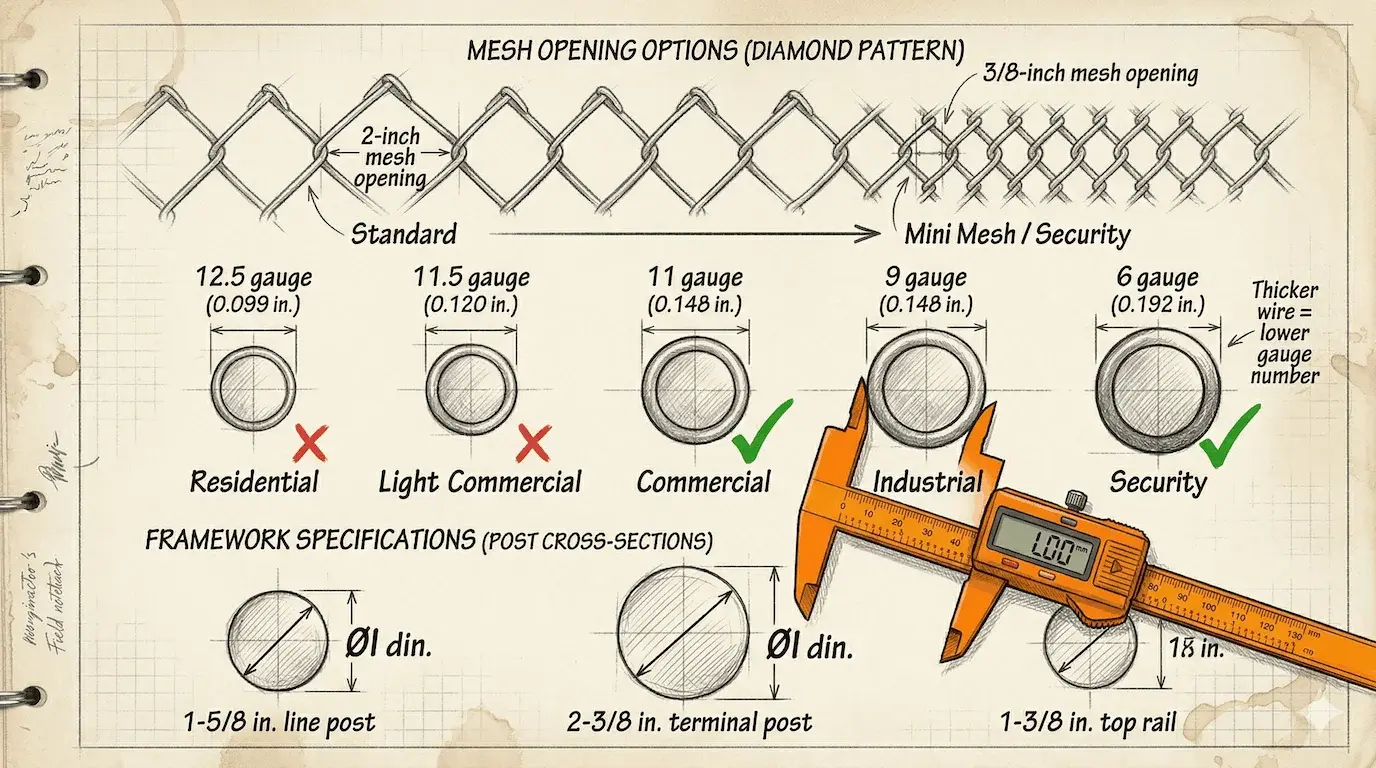
Wire gauge follows the American Wire Gauge (AWG) standard, where lower numbers mean thicker wire. The system dates back to the number of times wire was drawn through a die during manufacturing, so more draws meant thinner wire and a higher gauge number.
For chain link fence fabric, four gauges cover 95% of all installations: 6-gauge, 9-gauge, 11-gauge, and 11.5-gauge. The remaining 5% includes specialty gauges like 12.5 for temporary fencing and custom heavy gauges for high-security applications.
Gauge affects three things directly. First, tensile strength: a 9-gauge wire has a breaking strength of approximately 1,280 pounds, while an 11-gauge wire breaks at roughly 750 pounds. Second, lifespan: thicker wire takes longer to corrode through, adding 5 to 10 years of service life. Third, cost: 9-gauge fabric runs 30% to 45% more per roll than 11-gauge.
Chain Link Fence Gauge Chart: Complete Specifications
| Wire Gauge | Wire Diameter (inches) | Wire Diameter (mm) | Approx. Breaking Strength (lbs) | Typical Application | Cost Index |
|---|---|---|---|---|---|
| 6 gauge | 0.192 | 4.88 | 2,150 | High-security, prisons, military | $$$$ |
| 9 gauge | 0.148 | 3.76 | 1,280 | Commercial, industrial, schools, parks | $$$ |
| 11 gauge | 0.120 | 3.05 | 750 | Standard residential, light commercial | $$ |
| 11.5 gauge | 0.113 | 2.87 | 640 | Economy residential, temporary | $ |
| 12.5 gauge | 0.099 | 2.51 | 480 | Temporary construction fencing | $ |
Here's the practical translation. If a homeowner wants a backyard fence to keep a dog in, 11-gauge is the standard. If a school district needs perimeter fencing around a playground, 9-gauge is the minimum you should quote. If a corrections facility or military base needs security fencing, 6-gauge is the only option that meets federal specifications.
The cost difference between 11-gauge and 9-gauge on a typical 200-linear-foot residential job is $400 to $700 in materials. On a 1,000-foot commercial perimeter, the difference jumps to $2,500 to $4,000. Knowing your gauges lets you spec accurately and avoid leaving money on the table or eating costs on underspecified jobs.
Wire Gauge Selection by Project Type
| Project Type | Recommended Gauge | Mesh Size | Minimum Height | Coating |
|---|---|---|---|---|
| Residential backyard | 11 or 11.5 | 2" | 4 ft | Galvanized before weave |
| Residential with dogs | 11 | 2" | 4 to 6 ft | Galvanized before weave or vinyl-coated |
| Pool enclosure | 11 | 1-3/4" | 4 ft (code minimum varies) | Galvanized after weave or vinyl-coated |
| Commercial property | 9 | 2" | 6 ft | Galvanized after weave |
| School/playground | 9 | 1-3/4" | 6 ft | Vinyl-coated |
| Tennis court | 9 | 1-3/4" | 10 ft | Vinyl-coated (green or black) |
| Industrial/warehouse | 9 | 2" | 6 to 8 ft | Galvanized after weave |
| Highway/DOT | 9 | 2" | 6 ft | Galvanized after weave or aluminized |
| High security | 6 | 1" or 3/8" | 8 to 12 ft + barbed wire | Galvanized after weave |
| Temporary construction | 11.5 or 12.5 | 2" | 6 ft | Galvanized before weave |
Notice that schools and playgrounds specify vinyl-coated 9-gauge with 1-3/4-inch mesh. The vinyl coating eliminates sharp wire ends that could cut children, and the smaller mesh prevents small fingers from getting caught. These aren't suggestions. Most school districts include these specs in their bid documents, and failing to meet them disqualifies your bid.
Mesh Size Options Explained
Mesh size is the diamond opening measurement from one knuckle to the opposite knuckle. Four standard sizes cover virtually all chain link applications.
2-inch mesh. The most common size. Used in 80% of residential and standard commercial installations. Two-inch openings are large enough to be cost-effective (less wire per square foot) while small enough to keep most pets contained. A 2-inch mesh in 11-gauge weighs approximately 5.5 pounds per square foot.
1-3/4-inch mesh. A step up in security and containment. Required for pool enclosures in many jurisdictions because the smaller opening makes climbing more difficult for children. Also standard for tennis courts, baseball backstops, and school perimeters. Costs 10% to 15% more than 2-inch mesh due to additional wire per square foot.
1-inch mesh. Used for security applications, animal enclosures, and equipment protection. The tight mesh prevents tools, fingers, and small objects from passing through. Common around HVAC equipment, electrical substations, and storage yards containing small inventory. Weighs approximately 9.5 pounds per square foot in 9-gauge, nearly double the weight of 2-inch mesh.
3/8-inch mesh. Also called "mini mesh" or "security mesh." Used in high-security applications like detention facilities and evidence storage. The 3/8-inch opening prevents anything larger than a pencil from passing through. Extremely heavy: approximately 18 pounds per square foot in 6-gauge. Installation requires heavier framework and additional bracing. This is not a DIY product. It requires experienced crews and specialized stretching equipment.
Mesh Size Comparison Table
| Mesh Size | Diamond Opening | Weight (9 ga, per sq ft) | Wire per Sq Ft | Relative Cost | Climb Resistance |
|---|---|---|---|---|---|
| 2" | 2.000 in | 5.5 lbs | Lowest | Baseline | Low |
| 1-3/4" | 1.750 in | 6.3 lbs | 14% more | +10-15% | Moderate |
| 1" | 1.000 in | 9.5 lbs | 100% more | +60-80% | High |
| 3/8" | 0.375 in | 18.0 lbs | 430% more | +200-300% | Very high |
Climb resistance matters for security fencing. A 2-inch mesh gives climbers easy footholds. Reducing to 1-3/4-inch helps but won't stop a determined climber. At 1-inch, climbing becomes significantly harder because fingers can't grip through the mesh effectively. At 3/8-inch, climbing without tools is essentially impossible. Pair mesh size with barbed wire or razor ribbon at the top for a complete security solution.
Coating Types: Galvanized, Vinyl-Coated, and Aluminized
The wire coating determines corrosion resistance, appearance, and lifespan. Four coating methods are standard in the industry. Choosing the wrong one for the environment will cut your fence's lifespan in half.
Galvanized Before Weave (GBW)
Wire is galvanized (zinc-coated) as individual strands before being woven into chain link fabric. This is the economy option. The weaving process damages the zinc coating at every knuckle point, creating 40+ potential corrosion initiation sites per square foot. GBW fabric meets ASTM A392 Class 1 standards with a minimum zinc coating of 1.2 oz per square foot of wire surface.
Lifespan in typical conditions: 10 to 15 years. In coastal or high-humidity environments, expect 7 to 10 years before visible rust. GBW is acceptable for residential fences, temporary installations, and interior applications. Not recommended for commercial or industrial projects where longevity matters.
Galvanized After Weave (GAW)
The entire fabric is woven first, then dipped in molten zinc. This coats every surface, including the knuckle points that GBW misses. GAW fabric meets ASTM A392 Class 2 standards with a minimum zinc coating of 2.0 oz per square foot. That's 67% more zinc than GBW.
The difference is visible. GAW fabric has a smoother, more uniform silver appearance compared to the slightly mottled look of GBW. More importantly, it lasts 20 to 25 years in typical conditions and 15 to 18 years in coastal environments. GAW costs 20% to 30% more than GBW but delivers 60% to 80% more service life. For commercial and industrial work, GAW is the minimum acceptable coating.
Vinyl-Coated (PVC)
Wire is galvanized (either GBW or GAW) and then coated with a layer of PVC plastic. The vinyl layer adds 8 to 12 mils of thickness and comes in standard colors: black, green, brown, and white. Custom colors are available at 15% to 25% premium with minimum order quantities of 10 to 20 rolls.
Vinyl coating serves three purposes. It adds corrosion protection beyond the galvanizing alone, extending lifespan to 25 to 30 years. It eliminates sharp edges, making the fence safer for high-contact environments like schools, parks, and pool areas. And it improves aesthetics, which matters for residential installations where homeowners want the fence to blend with landscaping.
The quality difference between vinyl over GBW and vinyl over GAW is significant. If the vinyl layer cracks, chips, or wears (which happens at contact points after 10 to 15 years), the underlying galvanizing is your last line of defense. Vinyl over GAW gives you 20+ years of protection even if the vinyl fails. Vinyl over GBW gives you 7 to 10 years. Always specify "vinyl over GAW" for commercial and institutional projects.
For residential projects where privacy slats will be added, vinyl-coated fabric in a matching color creates a cohesive, finished look that homeowners appreciate. Black vinyl-coated fabric with black privacy slats is one of the most popular combinations in suburban markets.
Aluminized
Wire is coated with aluminum instead of zinc. Aluminized coating provides superior corrosion resistance in specific environments: salt air, acidic soil, and industrial atmospheric pollutants. Common along coastal highways, near chemical plants, and in regions with acid rain.
Aluminized fabric meets ASTM A491 standards. It costs 10% to 20% more than GAW but lasts 25 to 30 years even in aggressive environments where GAW would fail in 12 to 15 years. State DOT projects in coastal regions frequently specify aluminized fabric. If you're bidding DOT work in Florida, Texas, or the Carolinas, check the specification carefully for this requirement.
Coating Comparison Table
| Coating Type | ASTM Standard | Coating Thickness | Lifespan (inland) | Lifespan (coastal) | Cost vs. GBW | Best For |
|---|---|---|---|---|---|---|
| GBW (Galvanized Before Weave) | A392 Class 1 | 1.2 oz/sq ft zinc | 10-15 years | 7-10 years | Baseline | Residential, temporary |
| GAW (Galvanized After Weave) | A392 Class 2 | 2.0 oz/sq ft zinc | 20-25 years | 15-18 years | +20-30% | Commercial, industrial |
| Vinyl over GBW | A392 Class 1 + F668 | 1.2 oz zinc + 8-12 mil PVC | 20-25 years | 15-20 years | +40-60% | Residential aesthetic |
| Vinyl over GAW | A392 Class 2 + F668 | 2.0 oz zinc + 8-12 mil PVC | 25-30 years | 20-25 years | +60-80% | Schools, parks, pools |
| Aluminized | A491 | Aluminum alloy layer | 25-30 years | 25-30 years | +30-40% | Coastal, DOT, chemical |
Framework Specifications: Posts, Rails, and Hardware
The chain link fabric is only half the system. The framework that supports it, consisting of posts, top rail, and tension components, must be sized correctly or the fabric will sag, lean, or detach.
Post Specifications
Chain link fence uses two types of posts: line posts (spaced evenly along the fence run) and terminal posts (at ends, corners, and gate openings). Terminal posts are always larger diameter than line posts because they bear tension from the stretched fabric.
Standard post sizes follow Schedule 40 pipe dimensions. Residential fences use lighter pipe than commercial or industrial fences.
| Application | Fence Height | Line Post OD | Terminal Post OD | Post Spacing | Post Setting Depth |
|---|---|---|---|---|---|
| Residential | 3-4 ft | 1-5/8" | 2-3/8" | 10 ft max | 24-30 in |
| Residential | 5-6 ft | 2-3/8" | 2-7/8" | 10 ft max | 30-36 in |
| Commercial | 6 ft | 2-3/8" | 2-7/8" | 10 ft max | 36 in |
| Commercial | 8 ft | 2-7/8" | 4" | 10 ft max | 42 in |
| Industrial | 10 ft | 2-7/8" | 4" | 10 ft max | 48 in |
| High Security | 12 ft | 4" | 6-5/8" | 8 ft max | 54-60 in |
Post spacing for chain link is typically 10 feet on center. Unlike wood fence where 8-foot spacing matches panel width, chain link fabric comes in continuous rolls (typically 50 feet) and 10-foot spacing is the structural maximum for standard framework. For high-wind areas or fences over 8 feet, reduce spacing to 8 feet.
Top Rail
Top rail runs horizontally along the top of the fence, connecting post to post through loop caps on line posts and brace bands on terminal posts. Standard top rail is 1-3/8-inch OD for residential and 1-5/8-inch OD for commercial and industrial applications.
Top rail comes in 21-foot lengths that swage together (one end is crimped smaller to fit inside the next section). On a 200-foot fence run, you'll need 10 lengths of top rail. Always carry 1 extra length per 200 feet to account for cuts and adjustments.
Bottom rail is optional but recommended for commercial and security fences. It prevents the fabric from being lifted from the bottom, which is the easiest point of unauthorized entry. Bottom rail specs match top rail dimensions. Adding bottom rail increases material cost by 15% to 20% but significantly improves security.
Tension Wire
Tension wire (also called coil wire or bottom wire) runs along the bottom of the fence between terminal posts. Standard tension wire is 7-gauge galvanized, with a diameter of 0.177 inches. It prevents animals from pushing under the fence and helps maintain the bottom line's straightness.
Tension wire is tensioned with the same stretcher bar and bands used for the fabric. Install it 1 to 2 inches off the ground. For added security on commercial properties, install a second tension wire 12 inches above the first.
Tension Bars and Bands
Tension bars (also called stretcher bars) are flat steel bars woven through the end of the fabric at each terminal post. Standard dimensions: 3/16 inch thick by 3/4 inch wide, with lengths matching fence height (a 48-inch bar for a 4-foot fence, a 72-inch bar for a 6-foot fence). The tension bar connects to the terminal post using tension bands, typically spaced 12 to 15 inches apart, so a 6-foot fence needs 5 to 6 tension bands per terminal post.
How to Identify Wire Gauge in the Field
You'll encounter existing chain link fences that need matching, repair, or extension. Identifying the gauge without documentation requires a simple measurement.
Carry a wire gauge tool (available for $8 to $15 at any supply house) or a digital caliper. Measure the wire diameter at a straight section, not at a knuckle where the wire is bent and may have deformed slightly.
- 0.192 inches = 6 gauge
- 0.148 inches = 9 gauge
- 0.120 inches = 11 gauge
- 0.113 inches = 11.5 gauge
- 0.099 inches = 12.5 gauge
For vinyl-coated wire, measure the core wire, not the total diameter including coating. Strip a small section of vinyl with a utility knife to expose the bare wire, then measure. The vinyl adds 8 to 12 mils (0.008 to 0.012 inches) per side, so a vinyl-coated 9-gauge wire will measure approximately 0.164 to 0.172 inches total diameter.
Fabric Roll Sizes and Coverage
Chain link fabric ships in standard roll sizes. Knowing these helps you calculate material orders accurately.
Standard roll length: 50 feet. This is universal across all manufacturers and gauges. Some suppliers offer 100-foot rolls for large commercial orders at a 5% to 8% price reduction per linear foot.
Roll height matches fence height: 36 inches (3 ft), 42 inches (3.5 ft), 48 inches (4 ft), 60 inches (5 ft), 72 inches (6 ft), 84 inches (7 ft), 96 inches (8 ft), 120 inches (10 ft), and 144 inches (12 ft). Custom heights are available from most manufacturers with a 4 to 6 week lead time and minimum order quantities of 20 to 50 rolls.
Fabric weight per 50-foot roll varies significantly by gauge and mesh size. An 11-gauge, 2-inch mesh, 6-foot-tall roll weighs approximately 82 pounds. A 9-gauge, 2-inch mesh, 6-foot-tall roll weighs approximately 115 pounds. A 9-gauge, 1-inch mesh, 6-foot-tall roll weighs approximately 190 pounds. Plan your delivery and handling accordingly. Two workers can carry an 11-gauge roll easily. A 9-gauge, 1-inch mesh roll requires a pallet jack or two strong workers.
Stretching and Installation Notes by Gauge
Heavier gauge wire requires more stretching force, which means different equipment and techniques.
11 and 11.5 gauge. A standard fence stretcher with a come-along or ratchet puller provides adequate tension. One person can stretch 11-gauge fabric on runs up to 100 feet. Target stretch: fabric should deflect no more than 1 inch per foot of fence height when pressed by hand. For a 6-foot fence, pressing mid-span should produce no more than 6 inches of deflection.
9 gauge. Requires a mechanical fence stretcher or a vehicle-mounted pulling system. Two people should handle the stretching operation. Target tension: 300 to 400 pounds of pull force at the stretcher bar. Under-tensioned 9-gauge fabric sags visibly and looks unprofessional. Over-tensioned fabric stresses the terminal posts and can pull them out of plumb.
6 gauge. Heavy equipment required. A hydraulic fence stretcher rated for at least 2,000 pounds of pull force is necessary. Three-person crew minimum for 6-gauge installations: one operating the stretcher, one managing the fabric unroll, and one monitoring post alignment during tensioning. Terminal posts must be fully cured (48 hours minimum for concrete) before stretching 6-gauge fabric.
Pricing Guide: What Gauge Costs What
Material pricing fluctuates with steel and zinc markets, but the relative relationships between gauges remain consistent. These figures reflect mid-2026 wholesale pricing for contractors buying 10 or more rolls.
| Specification | Price per Linear Foot (fabric only) | Price per 50 ft Roll | Installed Cost per Linear Foot (4 ft height) | Installed Cost per Linear Foot (6 ft height) |
|---|---|---|---|---|
| 11.5 ga, 2" mesh, GBW | $1.20 - $1.60 | $60 - $80 | $8 - $12 | $12 - $16 |
| 11 ga, 2" mesh, GBW | $1.50 - $2.00 | $75 - $100 | $10 - $14 | $14 - $18 |
| 11 ga, 2" mesh, GAW | $1.90 - $2.50 | $95 - $125 | $12 - $16 | $16 - $22 |
| 9 ga, 2" mesh, GAW | $2.80 - $3.60 | $140 - $180 | $16 - $22 | $22 - $30 |
| 9 ga, 2" mesh, vinyl-coated | $3.50 - $4.50 | $175 - $225 | $20 - $26 | $26 - $35 |
| 6 ga, 2" mesh, GAW | $5.00 - $6.50 | $250 - $325 | $30 - $40 | $40 - $55 |
| 9 ga, 1" mesh, GAW | $5.50 - $7.00 | $275 - $350 | $32 - $42 | $42 - $58 |
Installed costs include posts, framework, hardware, concrete, and labor. Actual pricing varies by region, with coastal and metropolitan areas running 15% to 25% higher than rural markets. These numbers give you a baseline for estimating. Always verify current wholesale pricing with your supplier before submitting bids.
Spec Sheets and Standards to Know
When bidding commercial and government projects, you'll encounter references to specific ASTM standards. Here's what they mean and why they matter.
ASTM A392 covers zinc-coated (galvanized) steel chain link fence fabric. Class 1 is GBW with 1.2 oz/sq ft zinc. Class 2 is GAW with 2.0 oz/sq ft zinc. Most commercial specs require Class 2 minimum.
ASTM F668 covers vinyl-coated chain link fence fabric. It specifies minimum coating thickness (8 mils for standard, 15 mils for heavy-duty), adhesion requirements, and color consistency. Always check whether the spec calls for standard or heavy-duty vinyl.
ASTM A491 covers aluminum-coated (aluminized) steel chain link fence fabric. Less common than A392 but required for coastal DOT projects in many states.
ASTM F567 covers chain link fence installation. It specifies post depth, concrete requirements, framework assembly, and fabric tensioning. When a project spec references F567, it's telling you to follow the standard installation method rather than the contractor's preferred approach.
CLFMI (Chain Link Fence Manufacturers Institute) publishes product manuals and installation guides that serve as the industry reference. Their Product Manual is updated annually and covers specifications for every component in a chain link fence system. Keep a current copy in your truck. It's free to download from their website.
Matching Existing Fence for Repairs and Extensions
Adding a section to an existing chain link fence or repairing storm damage requires matching the existing specification exactly. Mismatched gauges create a weak point where the two fabrics tie together.
Steps to match an existing fence:
- Measure wire diameter with a caliper to determine gauge
- Measure mesh opening corner to corner to determine mesh size
- Check for vinyl coating (look at cut ends and knuckle points)
- Check for GAW vs GBW: GAW has a smoother, more uniform zinc appearance at the knuckles. GBW knuckles often show bare steel where zinc was scraped during weaving
- Measure post OD and wall thickness to match framework
- Note top rail size and whether bottom rail or tension wire is present
For repairs, you don't need to replace the entire fabric run. Remove the damaged section by unweaving a single strand at each end, creating a clean edge. Attach the new section using the same unweaving/re-weaving technique. Tie together with hog rings or fence ties every 12 inches along the splice. A skilled installer can splice a 10-foot section in 20 to 30 minutes.
Frequently Asked Questions
What gauge chain link fence is best for residential use?
Standard residential chain link uses 11-gauge wire with 2-inch mesh openings. This provides adequate strength for property boundaries, pet containment, and general security at a reasonable cost. For larger dogs (over 50 pounds) that may push against the fence, consider upgrading to 9-gauge, which increases material cost by about $400 to $700 on a typical 200-foot installation.
What is the difference between galvanized before weave and galvanized after weave?
Galvanized before weave (GBW) coats individual wires with zinc before weaving them into fabric, which damages the zinc at every knuckle point. Galvanized after weave (GAW) dips the finished fabric in molten zinc, coating every surface including knuckles. GAW provides 67% more zinc coverage, lasting 20 to 25 years versus 10 to 15 years for GBW. GAW costs 20% to 30% more but delivers significantly longer service life.
What gauge is required for commercial chain link fence?
Commercial chain link fence typically requires 9-gauge wire minimum, per most building codes and project specifications. Schools, parks, government facilities, and industrial properties all specify 9-gauge as the baseline. High-security applications like prisons and military bases require 6-gauge. Always check the project specification document carefully, as using a lighter gauge than specified will fail inspection.
How do I tell what gauge my existing chain link fence is?
Use a wire gauge tool or digital caliper to measure the wire diameter at a straight section between knuckles. Common measurements: 0.148 inches is 9-gauge, 0.120 inches is 11-gauge, and 0.113 inches is 11.5-gauge. For vinyl-coated wire, strip a small section of coating first to measure the bare wire. The vinyl adds 0.008 to 0.012 inches per side to the total diameter.
Does mesh size affect the cost of chain link fence?
Yes, significantly. Smaller mesh sizes use more wire per square foot, increasing both material weight and cost. Compared to standard 2-inch mesh, 1-3/4-inch mesh costs 10% to 15% more, 1-inch mesh costs 60% to 80% more, and 3/8-inch security mesh costs 200% to 300% more. The weight increase also affects shipping, handling, and installation labor, adding to the total installed cost per linear foot.